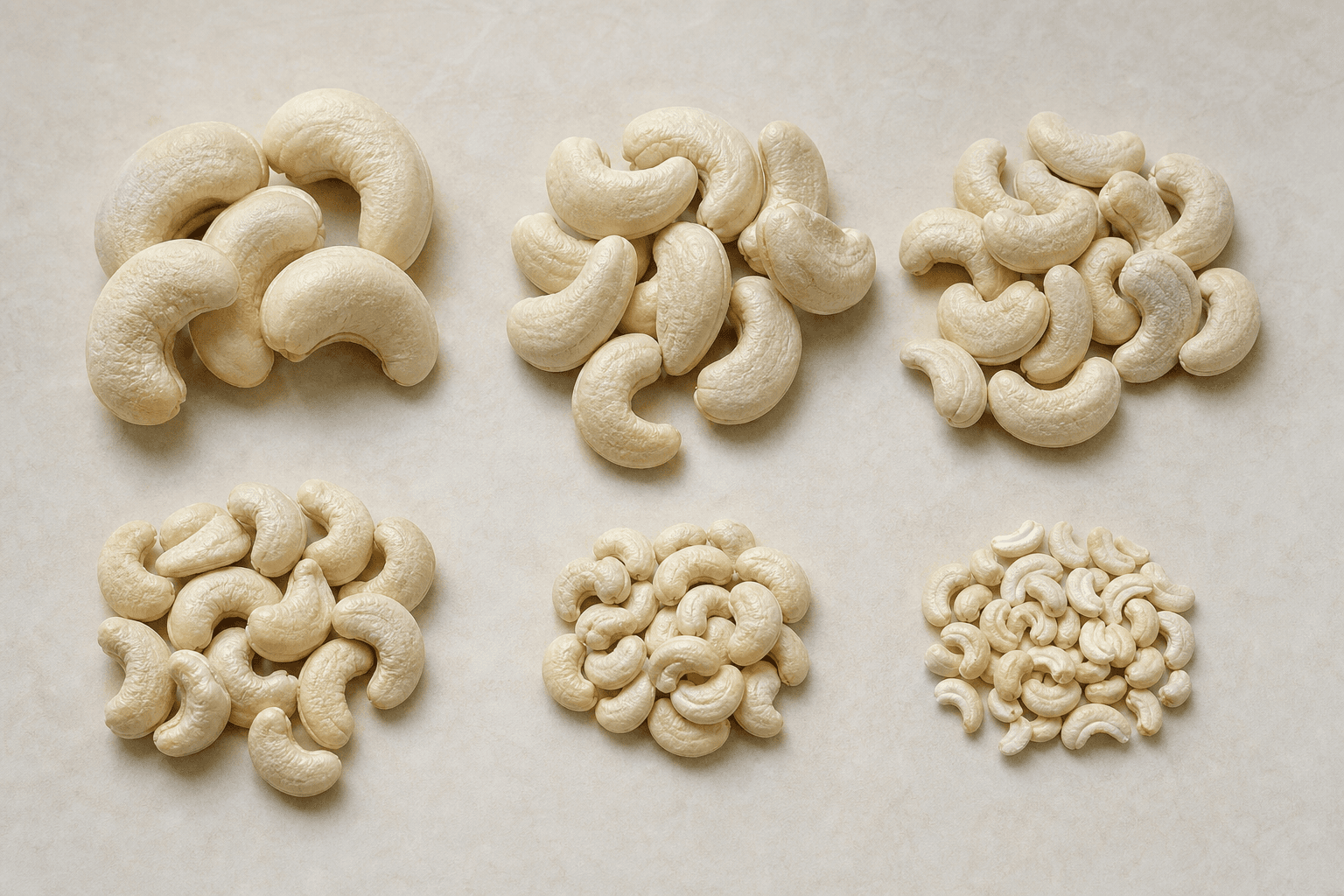
Cashew kernel grading can read like an industry code to a new buyer, but the system is logical and consistent once the parts are clear. Getting it right matters: the grade you specify drives both your price and how the kernel performs in your product, whether that is a retail snack pack or an ingredient for confectionery.
What the W numbers mean
The W stands for white whole kernels, and the number is the count of kernels per pound. A lower number means a larger nut, so W180 delivers roughly 170 to 180 kernels per pound and is the largest standard whole grade, while W500 is the smallest. W240 and W320 are the most widely traded sizes and suit most snack and ingredient uses. Larger grades carry a premium for their visual appeal.
Scorched grades and colour
Not every whole kernel is bright white. During shelling and drying, some kernels take on a light amber colour from heat. These are graded as scorched, marked SW, and follow the same count logic — so SW240 is a scorched whole kernel of W240 size. Scorched kernels are sound and fully edible; the difference is purely cosmetic, which makes them a sensible choice where the nut is roasted, coated or ground.
Splits and pieces
- WS, white splits — kernels cleanly halved along the natural seam.
- SS, scorched splits — halved kernels with a light amber colouring.
- LWP, large white pieces — broken kernels above a set sieve size.
- SWP, small white pieces — smaller fragments, common in butters and bakery use.
- Butts and bits — the smallest sound pieces, priced lowest and used in pastes.
“Pieces are not a lower quality of nut. They are a lower cost of presentation — and for grinding, baking or coating they often make the most commercial sense.”
— Asha Ngonyani, Quality Manager
A common mistake is to over-specify. Buying W240 wholes for a product that grinds the kernel anyway means paying for an appearance the customer never sees. Matching grade to end use — whole grades for visible snacking, splits and pieces for processing — is one of the simplest ways to control ingredient cost.
Specifying with confidence
A complete specification names the grade, the acceptable moisture level, defect tolerances and the food-safety standard the lot is processed under. We confirm each shipment against the agreed grade with kernel counts and defect checks before despatch, so the contract grade and the delivered grade are the same thing. That consistency, lot after lot, is what makes a supplier worth keeping.
Leave a Comment
Your email address will not be published.