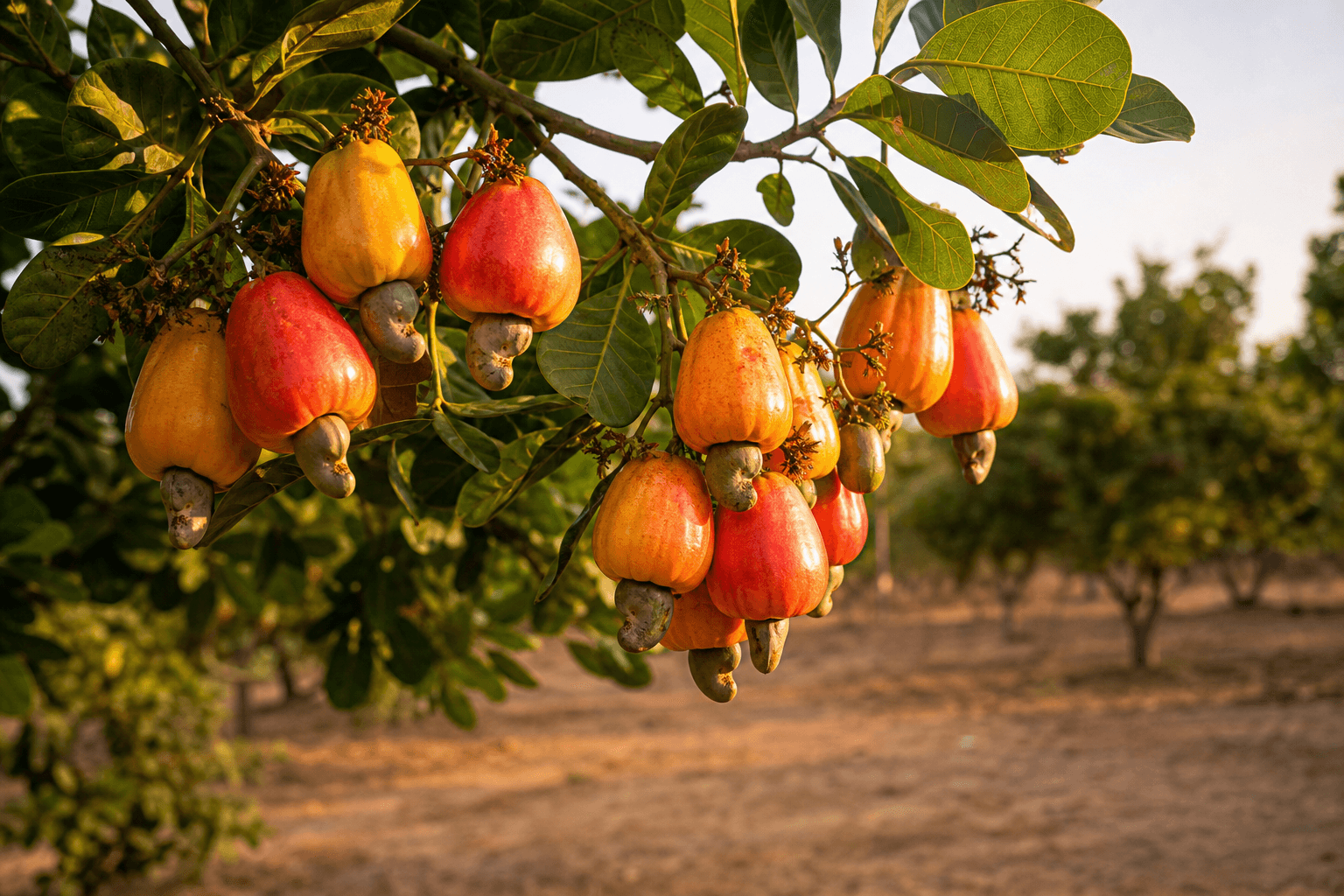
The Tanzanian cashew season runs on a rhythm the trade plans around every year. In the southern regions of Mtwara, Lindi, Ruvuma and Tunduru, the cycle moves from flowering through fruit set to a harvest window that opens in October and runs into January. Knowing where a crop sits in that cycle tells a buyer a great deal about the nut they are about to receive.
Blossom and fruit set
Flowering begins around June and July as the dry season settles in. The tree pushes out panicles carrying both male and hermaphrodite flowers, and only the latter set fruit. Dry, stable weather during this stretch is critical: unseasonal rain or high humidity encourages powdery mildew and anthracnose, which can thin a panicle before a single nut forms. A clean flowering is the first quiet signal of a strong out-turn later.
The harvest window
From October the cashew apple swells and the kernel inside the shell matures. Growers wait for nuts to drop naturally rather than stripping the tree, because a fallen nut is a fully developed one. Pickers collect daily, separate the nut from the apple, and sun-dry the raw cashew nuts on raised racks or clean tarpaulins until moisture sits at a safe 8 to 10 per cent for storage and bagging.
“A nut that falls on its own has finished maturing. The skill of a good harvest is patience, not speed — and it shows up months later in the kernel count.”
— Joachim Mbwana, Sourcing Lead
Drying is where many quality problems are made or avoided. Nuts left in heaps or dried on bare ground pick up moisture and soil contact, and that is exactly the condition aflatoxin-producing moulds need. We work with grower groups to keep nuts off the ground and to bag only once moisture is measured, not estimated.
What season timing tells a buyer
- Early-season nuts are usually drier and grade well, having matured in peak dry weather.
- Mid-season volume is highest, giving the most flexibility on contract sizing.
- Late-season lots need closer moisture and out-turn checks as humidity rises.
- A wet flowering period often predicts a lower out-turn before harvest even begins.
- Nut count per kilogram, recorded at intake, confirms how the season actually performed.
For an importer or processor, the practical takeaway is that a single label of 'Tanzanian cashew' covers very different nuts across one season. Sourcing with regional and date-of-harvest detail lets us match a specific lot to a buyer's grade and price expectations, and gives the traceability that serious food-safety programmes now require.
Leave a Comment
Your email address will not be published.