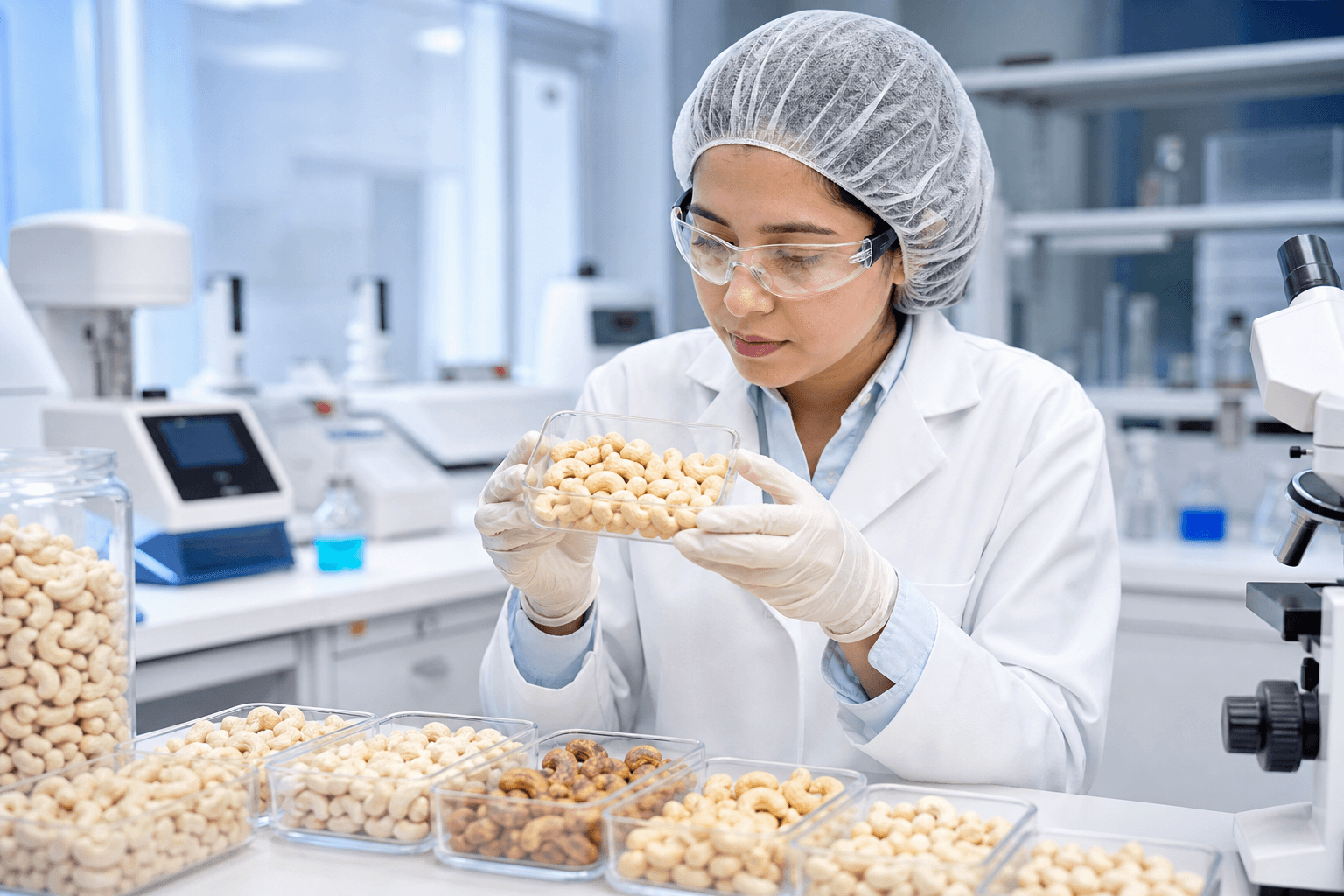
Aflatoxin is the single most important food-safety risk in the nut trade. Produced by Aspergillus moulds, it forms when nuts are exposed to warmth and moisture at the wrong moments, and importing countries enforce strict limits at the border. Keeping it out is not one test at the end — it is a chain of controls that begins in the field.
Where the risk starts
The danger window opens at harvest. Raw cashew nuts left on damp ground, dried in heaps or bagged before they reach safe moisture give Aspergillus the conditions it needs. By the time a mould problem is visible, the toxin may already be present. That is why our controls focus first on prevention at the farm and drying stage, long before a lot reaches the warehouse.
Controls from farm to container
- Drying raw nuts on raised racks and clean tarpaulins, never bare soil.
- Confirming moisture sits at 8 to 10 per cent with meters before bagging.
- Storing in ventilated, dry warehouses on pallets, clear of walls and floor.
- Sorting out discoloured, shrivelled and mould-marked nuts at intake and shelling.
- Laboratory aflatoxin testing on representative samples before any shipment.
“You cannot test aflatoxin out of a bad lot. You can only keep it from forming in the first place — and that work happens in the sun on a drying rack, not in the lab.”
— Asha Ngonyani, Quality Manager
Testing and documentation
Prevention is the priority, but verification still matters. We draw representative samples across a lot and test against the limit set by the destination market, since thresholds differ between the EU and other regions. Results are documented and tied to the specific lot, so every shipment carries proof — not just a promise — of the food-safety standard it was processed under.
Why the system holds
Our ISO 22000 and HACCP framework is what keeps these steps consistent rather than occasional. Each control point has a defined limit, a check and a record, from drying through to despatch. For a buyer, that means an aflatoxin-compliant shipment is the predictable result of a managed process, lot after lot, not a matter of luck with a particular crop.
Leave a Comment
Your email address will not be published.