

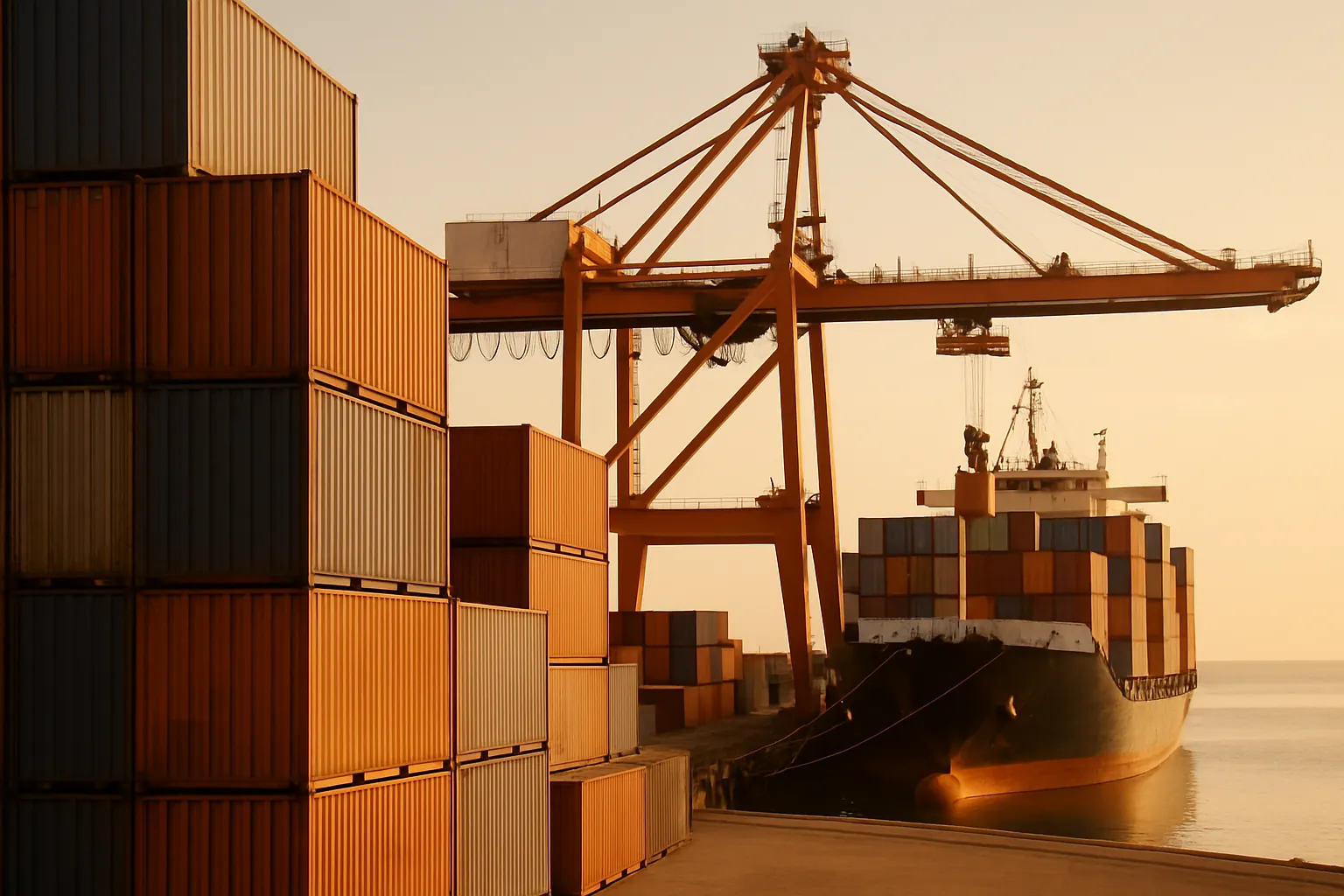
Three ports move nearly everything Afri Exports ships: Dar es Salaam and Mtwara in Tanzania, plus Mombasa in Kenya for refrigerated cargo. Each corridor has a personality — sailing frequencies, transhipment habits and seasonal moods — and a buyer who understands them will read our shipment schedules the way we do, instead of measuring every delay against a carrier's published best case.
Dar es Salaam — the workhorse
Dar es Salaam handles the bulk of Tanzania's containerised trade and is our default gate for sesame and for cashew kernels shipped outside the southern season peak. Mainline and feeder services connect it to the major hubs — Salalah, Jebel Ali and Colombo — which is both its strength and its catch: most cargo to Europe or the Far East tranships at one of those hubs, and a missed connection there adds a week that no one at the origin port can control.
Mtwara — the seasonal specialist
Mtwara sits in the middle of the southern cashew belt, and during the raw-nut export season its stuffing yards run at a pace the port never sees the rest of the year. Loading at Mtwara saves the 550-kilometre road leg to Dar es Salaam — real money and real risk off the table for southern-origin cargo — but sailings are thinner and mostly feeder-based, so we book earlier and build more buffer into the schedule.
Mombasa — the reefer gate
Mombasa is not a Tanzanian port, and for dry cargo it is rarely worth the road leg and the border. For refrigerated cargo it is a different calculation entirely. East Africa's reefer capacity and sailing frequency are concentrated there, and perishable fruit cannot wait for a better schedule out of Dar es Salaam — so our avocados are trucked north and loaded at Mombasa, which is what most Tanzanian avocado exporters do. It also carries a deeper liner service than either Tanzanian port, which occasionally makes it worth considering for a buyer consolidating several East African origins into one arrival.
Realistic transit times
- Dar es Salaam to Jebel Ali / Middle East: roughly 8–14 days on direct or single-feeder routings.
- Dar es Salaam to Indian west-coast ports (Nhava Sheva, Mundra): roughly 10–18 days.
- Dar es Salaam to South-East Asia (Ho Chi Minh, Port Klang): roughly 20–30 days, almost always via transhipment.
- Dar es Salaam to North Europe (Rotterdam, Hamburg): roughly 25–35 days depending on the hub connection.
- Mombasa to North Europe: roughly 22–30 days, generally a few days quicker than Dar es Salaam on the same lane.
- Add 5–10 days of honest buffer in peak season — schedules are advertisements, not promises.
“The corridor chooses the schedule, not the carrier's brochure. We quote the transit time we have actually seen, then work to beat it.”
- Daniel Mahenge, Logistics Coordinator
Container versus LCL
A full container is the clean option: one shipper, one seal, no co-loaded cargo touching yours. A 20-foot box takes roughly 15–16 tonnes of bagged sesame or raw cashew, around 700 cartons of kernels, or about 18 tonnes of honey in 300 kg drums — honey is the one product where you hit the weight limit long before you run out of space. LCL — buying space by the cubic metre in a shared container — makes sense for trial orders and pallet-scale parcels, but it adds handling at both ends, more parties to the paperwork and usually a week or more to the door-to-door time. Our rule of thumb: LCL to test a supplier, FCL to run a programme.
Related reading


Leave a Comment
Your email address will not be published.