

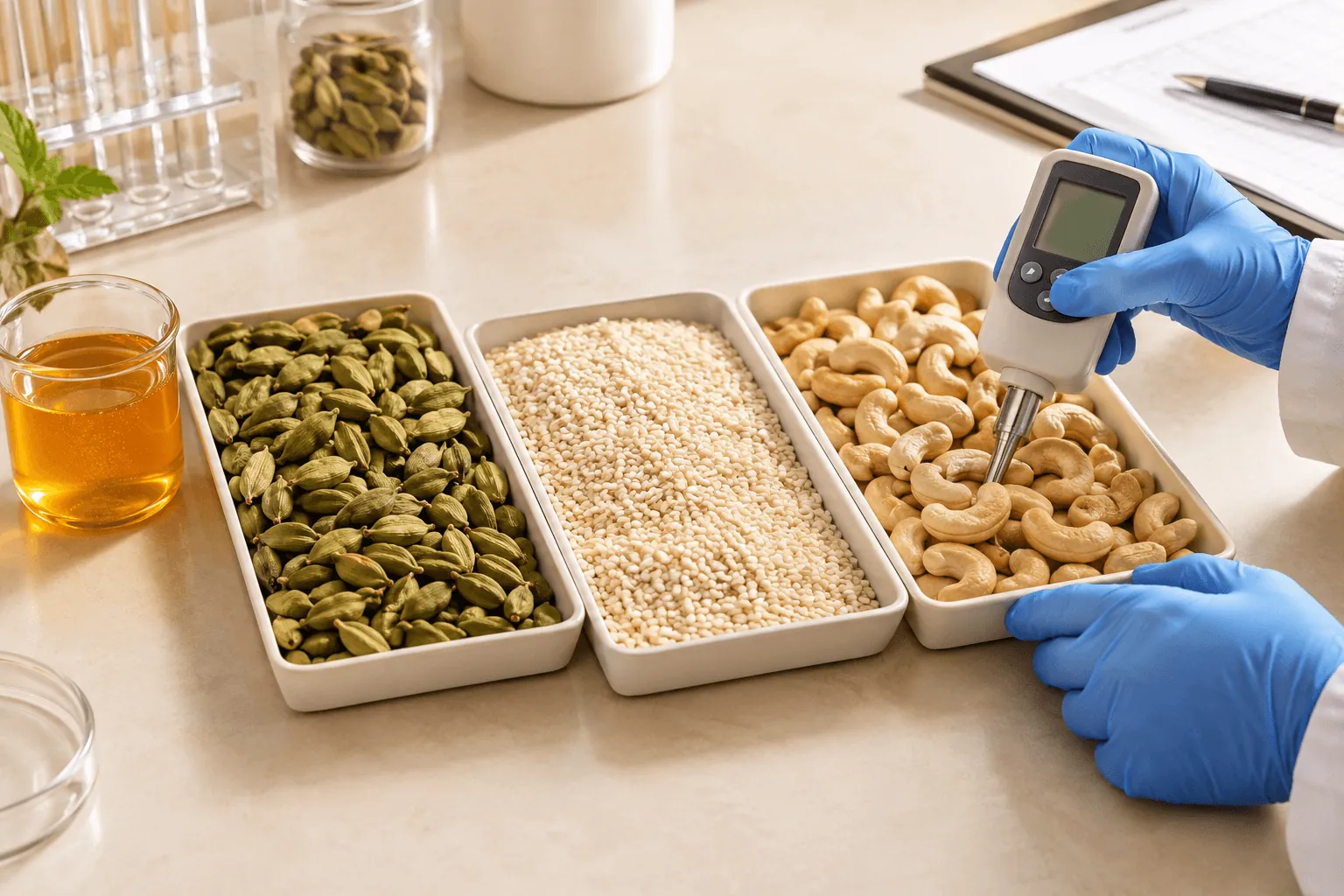
Our quality system is one discipline applied through three rulebooks. The discipline — documented sampling, calibrated instruments, independent lab confirmation and a retained sample from every export lot — never changes. The rulebook does, because a cashew kernel, a sesame seed and a drum of raw honey fail in completely different ways, and a QC programme that treats them the same will miss the failure that matters.
What every lot goes through
- Sampling at intake against a written protocol — probes from a fixed proportion of bags, never a surface scoop from the doorway stack.
- Moisture read on calibrated meters, with the calibration log available to any buyer who asks.
- An independent laboratory analysis on the composite sample before the lot is confirmed for export.
- A sealed retained sample held from every export lot, so a dispute months later can be tested against the same material we shipped.
- Third-party pre-shipment inspection (SGS, Bureau Veritas or equivalent) arranged at the buyer's option — we quote it into the deal rather than resisting it.
Where the rulebooks diverge
For Tanzanian cashew, the intake questions are moisture, nut count and out-turn — the numbers that tell you what the shell is hiding. Processing runs in TBS-registered facilities and the kernel side adds defect counts and grade verification against the contract. For Tanzanian sesame, the lab work shifts to purity, admixture, oil content and free fatty acid — a seed lot can look clean to the eye and still carry admixture that fails a crushing or hulling spec.
Honey inverts the sequence, and that is the interesting part. Cashew and sesame can be re-cleaned, re-sorted and re-graded right up to the moment they are bagged; honey cannot. Once a collection is bulked into a 300 kg drum it is one homogeneous thing, and a single fermenting bucket taints the lot around it. So our control point moves forward, to the bulking bench: every beekeeper's delivery is checked for moisture before it is allowed into the drum, and the full panel — HMF, diastase, sugar profile — is run on the bulked lot before it is sealed and moves to the port.
“A multi-commodity exporter earns trust one rejection at a time. The lots we refused to ship are the reason buyers accept the ones we do.”
- Asha Ngonyani, Quality Manager
Lots we turned away
The system only means something if it stops shipments, so here are three it stopped. A sesame lot arrived with paperwork claiming 99 per cent purity; our intake sieve analysis put admixture above 2 per cent, and the lot went back to the aggregator rather than into a container. A raw cashew parcel offered late in the season read 11 per cent moisture against our 10 per cent ceiling — tempting volume in a tight month, but a moisture problem in Mtwara becomes a mould problem in a ship's hold, so we declined it. And a honey collection was turned away at the bulking bench reading above 20 per cent moisture — harvested a little early, still perfectly good honey for the domestic market, but a fermentation risk in a container crossing the equator.
None of these stories are comfortable, and that is the point. A supplier who tells you every lot passed is describing a QC system that never says no. Ours says no several times a season, and the paperwork behind each refusal is part of the record we can walk a serious buyer through.
Go deeper on how we work
- From Smallholder to Container: How Traceability Works- the lot-numbering system behind every QC record
- How to Write a Bulk Honey Specification- why honey has to be cleared before it is drummed
- Our commodities- cashew, sesame, cardamom and raw honey specifications
- Buyer FAQ- inspection, sampling and documentation questions answered
Related reading
Leave a Comment
Your email address will not be published.