

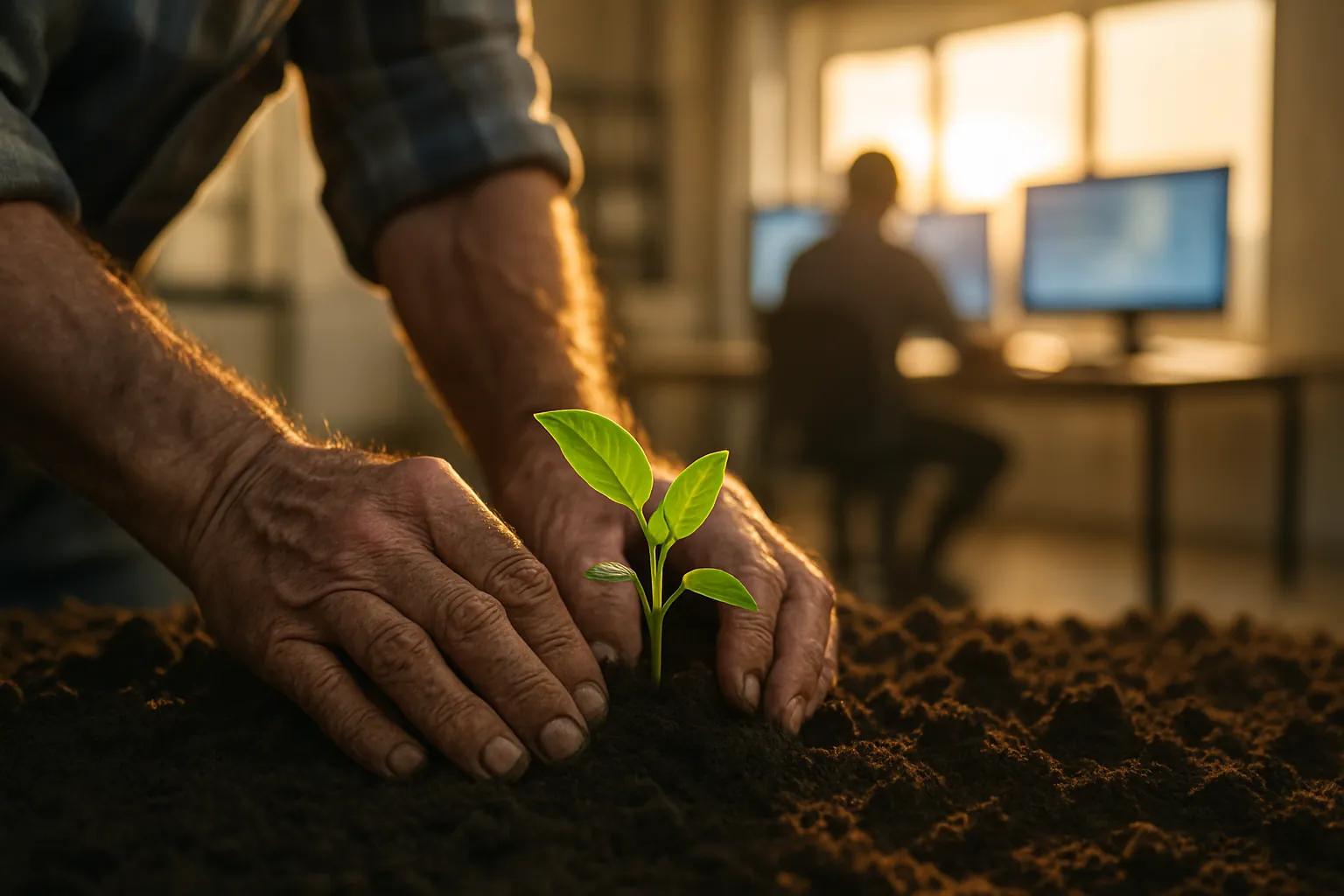
At a glance
- AI is transforming knowledge work, but crops are physical, biological and seasonal — no model can prompt a cashew tree into fruiting or make the miombo flower earlier than the rains allow.
- Forest honey is the clearest case: the harvest is set by bees and bloom, and the work is carried out by beekeepers climbing to hives hung in standing woodland.
- Cashew and sesame are smallholder crops — picked, dried, threshed and bagged by people across thousands of small farms, not by anything with an API.
- What AI does transform is the trade around the crop: optical sorting, export documentation, traceability records, market analysis and buyer-supplier matching.
- Machine-vision colour sorters were remaking cashew-kernel and sesame processing before the current AI wave — today's change is an acceleration, not a novelty.
- Our own export desk uses AI for documentation drafting and market monitoring; no algorithm clears a lot for shipment — a person does, against a laboratory result.
It is a fair question in 2026: if AI can write code, pass exams and draft contracts, what happens to a business like ours — an export house whose products grow on trees and in fields? Our answer, from inside the trade, comes in two parts. The crop itself sits beyond automation of the prompt-driven kind, for reasons that are biological rather than technological. But the trade wrapped around the crop — the sorting, the paperwork, the records, the market intelligence — is changing quickly, and buyers who understand which half is which will read every supplier's claims about AI far more shrewdly.
Why can't AI replace farming itself?
Because a crop is a physical, biological event on a seasonal clock, and software has no hands. AI systems manipulate information; a harvest is not information — it is fruit on a tree, seed in a field and weather over a district.
Honey makes the point better than any thought experiment, because the primary producer is not even human. The size of a miombo honey crop is decided by when the woodland flowers and how the rains behaved six months earlier, and it is gathered by colonies that will abscond if the season turns against them. The people involved hang hollowed log hives in the branches, wait, and then climb up to take the combs down. The honey is then settled, strained and drummed by hand within a few days, because the alternative is fermentation. There is no prompt for any of this, and there is unlikely ever to be.
Cashew is less romantic but no more automatable. Tanzania's crop comes off smallholder farms across the southern belt; the nuts are gathered by hand, sun-dried on mats and moved through village aggregation before they ever meet a machine. Sesame is the same story in a different season — rain-fed smallholder fields, hand harvesting, field drying, threshing. The supply of every product we sell is set by rainfall, flowering and farm-gate decisions made by enormous numbers of individual farmers and beekeepers. A model can describe that system. It cannot operate it.
Which parts of the trade is AI genuinely transforming?
The information work wrapped around the physical crop — and in an export trade, that wrapping is thick. Five areas stand out.
- Optical sorting and grading — machine-vision colour sorters inspect every kernel or seed in a moving stream and eject defects at speeds no hand line approaches. This is the oldest machine intelligence in the trade, and it is why tight purity specifications are commercially deliverable at scale.
- Documentation — an export shipment generates a stack of certificates, invoices and declarations that must agree with each other to the letter. Drafting and cross-checking that stack is exactly the repetitive, error-prone text work language models are good at.
- Traceability records — intake logs, lot numbers, moisture readings and consolidation records digitise well, and AI makes them queryable: a buyer's question about one container can be answered from the records in minutes rather than days.
- Market analysis — assistants can watch auction reports, freight movements and origin news continuously and summarise what changed, a job that used to consume a trader's mornings.
- Buyer-supplier matching — search and AI assistants increasingly mediate how importers find exporters, which quietly rewards suppliers whose specifications are published, structured and honest.
What does this look like for cashew, sesame and honey?
Differently for each commodity — which is itself the lesson. The technology lands where the product is uniform and the decision is visual; it stalls where the judgement is sensory.
Cashew kernels are the natural home for machine vision: a colour sorter picks scorched or spotted kernels out of a white stream far faster than any hand line, and it is standard equipment in the kind of TBS-registered facilities our kernels move through. Sesame is even more machine-suited — modern cleaning lines combine sieves, destoners and optical sorters to push natural white sesame toward the purity levels tahini and bakery buyers specify. Honey sits at the other pole, and for an instructive reason: there is nothing to sort. A drum is one homogeneous liquid, so the quality decision has to be made before bulking, by a person with a refractometer standing in front of a beekeeper's bucket. What digitises in honey is the record — which groups, which collection round, which moisture reading went into which drum — not the decision itself.
How does Afri Exports use AI today?
Modestly, and in the office rather than the warehouse. Our export desk uses AI tools to draft and cross-check shipping documentation and to monitor market and freight news across our product families.
That deserves honest framing: the drafts are checked by the people whose names are on the documents, and the market summaries are a starting point for calls to the origin, not a substitute for them. No algorithm clears a lot for export — a person does, against a laboratory result and an intake record. We also publish machine-readable summaries of our specifications (llms.txt files) on all our sites, so that an AI assistant researching on a buyer's behalf can read our actual numbers rather than a third-hand version. A small thing, but a sign of where the trade's information layer is going — our companion guide, linked below, covers that buyer's side in full.
What should buyers take away from this?
Judge suppliers on the physical fundamentals, because those are the part AI cannot fake or fix: the crop relationships, the sampling, the laboratory discipline, the traceability. Then expect the good suppliers to be measurably better at the information work — faster documents, cleaner records, quicker answers — because they are using the same tools everyone else is.
A supplier who claims AI has revolutionised their beans should be asked the older questions: which districts, whose lab, where is the retained sample. The technology changes the wrapping. The crop, and the trust, are still built by hand.
“The tree does not read a forecast, and the flower will not wait for a software update. Our job is still to be standing in the right district when the crop comes off — AI just helps the paperwork keep up.”
- Joachim Mbwana, Sourcing Lead
See the physical side of the trade
- Using AI Agents for B2B Commodity Sourcing and Outreach- the companion guide: putting AI to work as a buyer
- From Smallholder to Container: How Traceability Works- the records AI makes queryable — and the hands behind them
- How We Run Quality Control Across Three Commodities- the sampling-and-lab discipline no model replaces
- Our commodities- the cashew, sesame, cardamom and honey behind the paperwork
- Buyer FAQ- sourcing and quality questions answered by people
- Talk to the export desk- a human reply within one business day
Related reading
Leave a Comment
Your email address will not be published.