

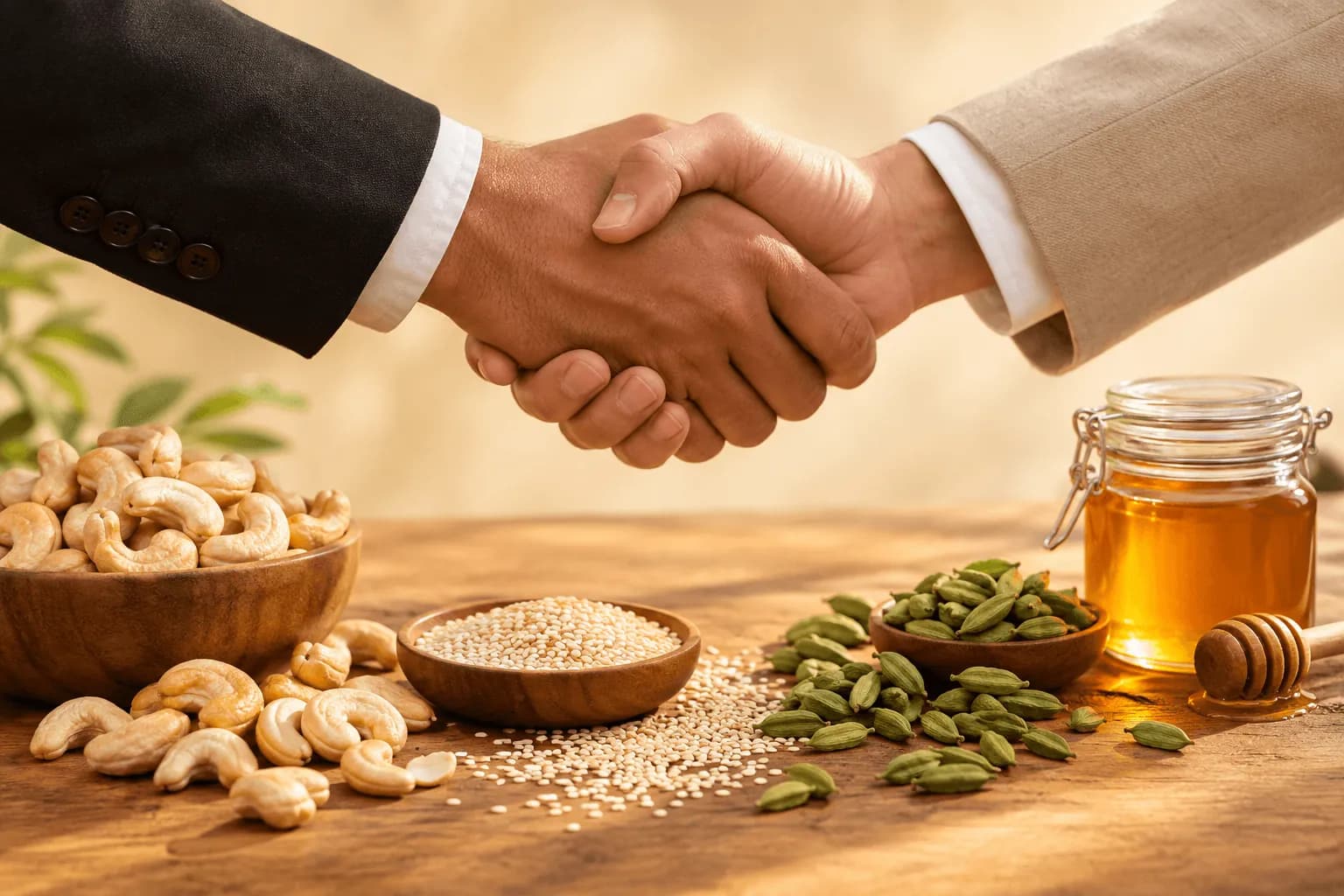
Tanzania sells a lot of food to the world, and almost none of the people buying it started out knowing how the trade works. This is the page we wish had existed when we started: what the country actually exports, how a deal is assembled from a first enquiry to a paid invoice, and the handful of things that catch out every newcomer regardless of which crop they are handling.
What Tanzania actually exports
Cashew is the headline. Tanzania is Africa's largest grower and sits among the leading producers globally, with the crop concentrated in the southern belt around Mtwara, Lindi, Ruvuma and Tunduru and export earnings reported in the hundreds of millions of dollars a year. Sesame is the other major export seed, grown widely and moved through a regulated warehouse receipt and auction system. Green cardamom grows in the mountain forests of Morogoro and the Usambaras, though Tanzania is a small player against Guatemala and India and it is worth being honest about that with buyers.
Honey is the export most people miss. Tanzania is among Africa's largest producers, and almost all of it comes out of the miombo — the Brachystegia woodland that covers much of the west and centre of the country — worked with hives hung in standing forest rather than trucked between crops. Tabora alone has enough beekeeping history to be called the country's honey capital, and the sector has the EU market access to match.
The skeleton that never changes
We recently wrote a set of beginner courses, one per commodity, and writing them back to back surfaced something we had not expected: underneath four very different products sits one shared commercial skeleton, and almost all the difficulty for a newcomer lives in a small number of product-specific forks.
Every deal follows the same sequence, because the sequence is what protects both sides. A buyer sends something vague. It is turned into a written specification. The supplier is verified and the stock is confirmed to physically exist, cleaned or cured and sitting in a warehouse rather than still on the plant. A sample is approved. Payment and delivery terms are agreed. Paper is issued that matches itself. The cargo is inspected, loaded and sealed. Payment is secured before control of the goods is lost.
Learn that once and it transfers to any crop. The reason a newcomer feels lost is almost never the sequence; it is the vocabulary sitting on top of it.
The forks that always change
- Cashew: raw nuts in shell (RCN) or kernels. Raw nuts are measured by out-turn (KOR), nut count, moisture and defects; kernels by W-grade, shape and colour.
- Sesame: natural or hulled, then colour class. Measured by purity, oil content, free fatty acid and moisture.
- Honey: light or dark crop, then bulk or retail format. Measured by moisture, HMF, diastase activity and colour on the Pfund scale, with added-sugar adulteration a live risk.
- Cardamom: green or black, then whole pods or seeds. Measured by size band in millimetres, colour, density and volatile oil in millilitres per 100 grams.
Notice the pattern. In every case the first question is which product, the second is which grade, and the third is which numbers prove it. A price quoted without all three is not a price.
Three things that catch newcomers in every crop
First, a grade is not a specification. W320, 99.5 purity, Grade A, 8 mm: each is one attribute. A full specification adds moisture, defect tolerances, packaging, food-safety testing and the standard it is all measured against. The certificate of analysis then proves what the tested lot actually achieved, and buyers expect the two to match.
Second, sea terms and air terms are not interchangeable. FOB, CFR and CIF exist for goods loaded aboard a vessel. For air or multimodal movement the correct terms are FCA, CPT and CIP. This matters more than it sounds: cardamom sometimes flies and samples almost always do, and while an ocean bill of lading is a document of title, an air waybill is only a receipt. If cargo flies, payment security has to be settled before departure.
Third, transit time is not lead time. Between a buyer's yes and goods on a shelf sit stock confirmation, sample approval, processing, a booking cutoff, the voyage itself, then customs and final delivery. Freight disruption through 2026 has widened every one of those gaps, which is why we now write short validity windows into quotations rather than leaving them open.
The paperwork layer
Exporting food crops from Tanzania needs a registered business with tax registration and an export permit from the Ministry of Agriculture for each consignment. Plant-health certification sits with TPHPA where the destination requires it. TBS administers standards, with shipment testing by TBS or another appropriately accredited laboratory. Customs clearance runs through a licensed clearing agent. Individual crops add their own layer, most notably the Cashewnut Board licensing and auction system for raw cashew. All of it changes between seasons, so treat any list, including this one, as something to verify rather than memorise.
If you are working as an agent rather than an exporter, you hold none of these permits and do not need to. What you need is to know who does: who is the contractual seller, who is the exporter of record, whether their registrations are current, who obtains the permits and certificates, and who carries the cost if paperwork stops the shipment.
Where to start
Watch the course for the commodity you are actually being asked about, then skim one other. The second one is where the skeleton becomes visible, because you will recognise the structure while the vocabulary changes underneath it. Each runs about fifteen minutes and each has a written companion page with the numbers laid out for reference.
Free courses and guides, one per product family:
Related reading
Leave a Comment
Your email address will not be published.