
At a glance
- Tanzania produces over 30,000 tonnes of honey a year and ranks among Africa's largest producers, yet exports only a small share of it.
- Almost all of it is forest honey from the miombo woodland of the west and centre — Tabora, Katavi, Kigoma, Singida and Shinyanga.
- Two crops: a light golden honey from the main May-to-August flow, and a darker, stronger harvest later in the year.
- Bulk specification runs on moisture (under 20%), HMF (under 40 mg/kg), diastase (at least 8 DN) and colour on the Pfund scale.
- Tanzania holds EU third-country approval for honey, supported by a national residue-monitoring plan administered by the Tanzania Forest Services Agency.
- Standard packing is the 300 kg food-grade drum; a 20-foot container carries roughly 18 tonnes.
Most buyers who come to us for honey arrived by accident. They were looking at cashew or sesame, saw honey on the list, and asked the obvious question: why would a Tanzanian exporter sell honey? The answer is that Tanzania is quietly one of the largest honey producers on the continent, and has been for as long as anyone has been counting — it just does not market itself the way Argentina, Vietnam or India do. This is a guide to what the product actually is, before anyone asks us for a price.
What is miombo honey?
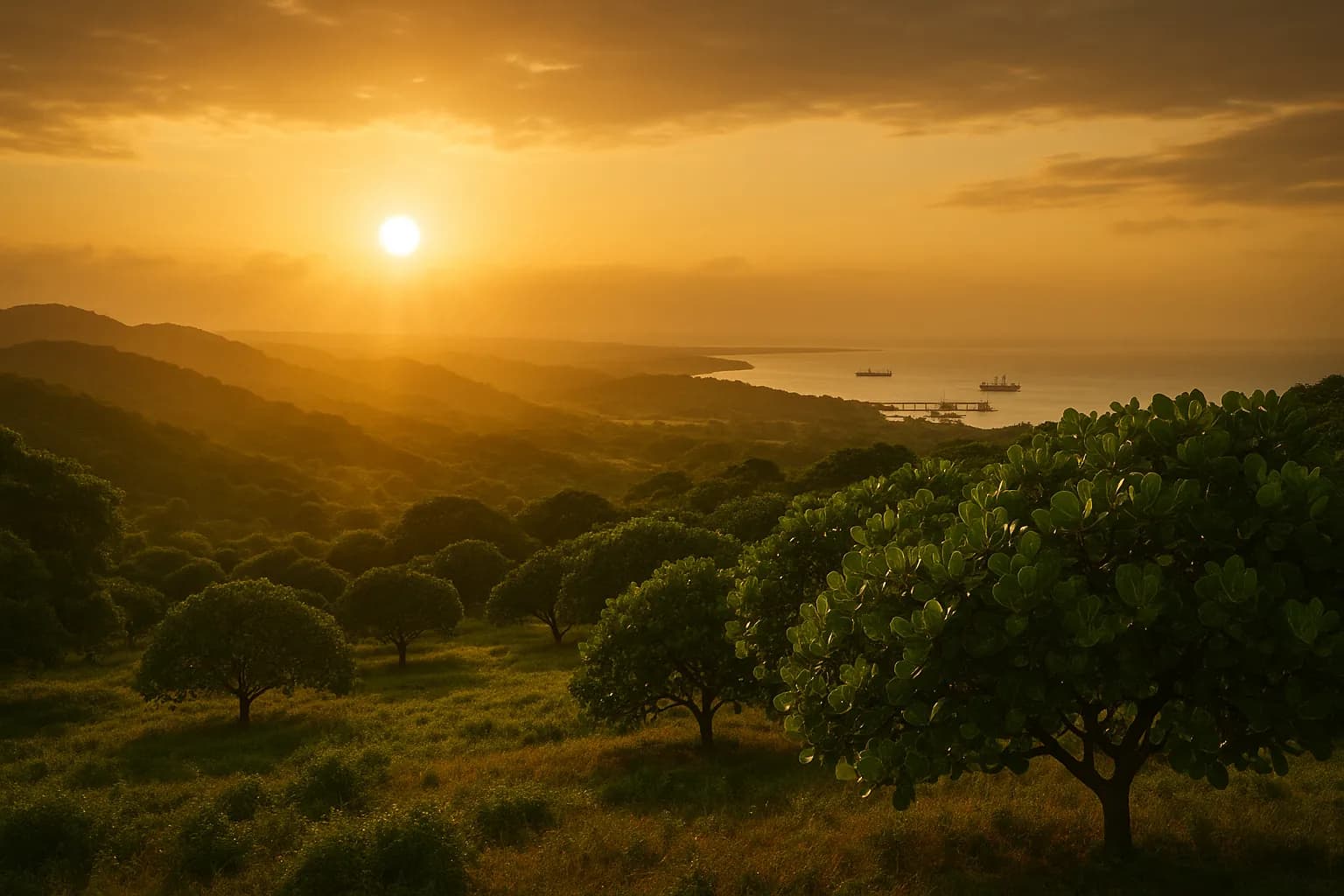
Miombo is the name for the open, dry woodland dominated by Brachystegia and Julbernardia trees that stretches across western and central Tanzania and on into Zambia, Malawi and Mozambique. It is not farmland and it is not rainforest. It is a vast, seasonally flowering tree system, and it is the reason Tanzanian honey exists in the quantities it does.
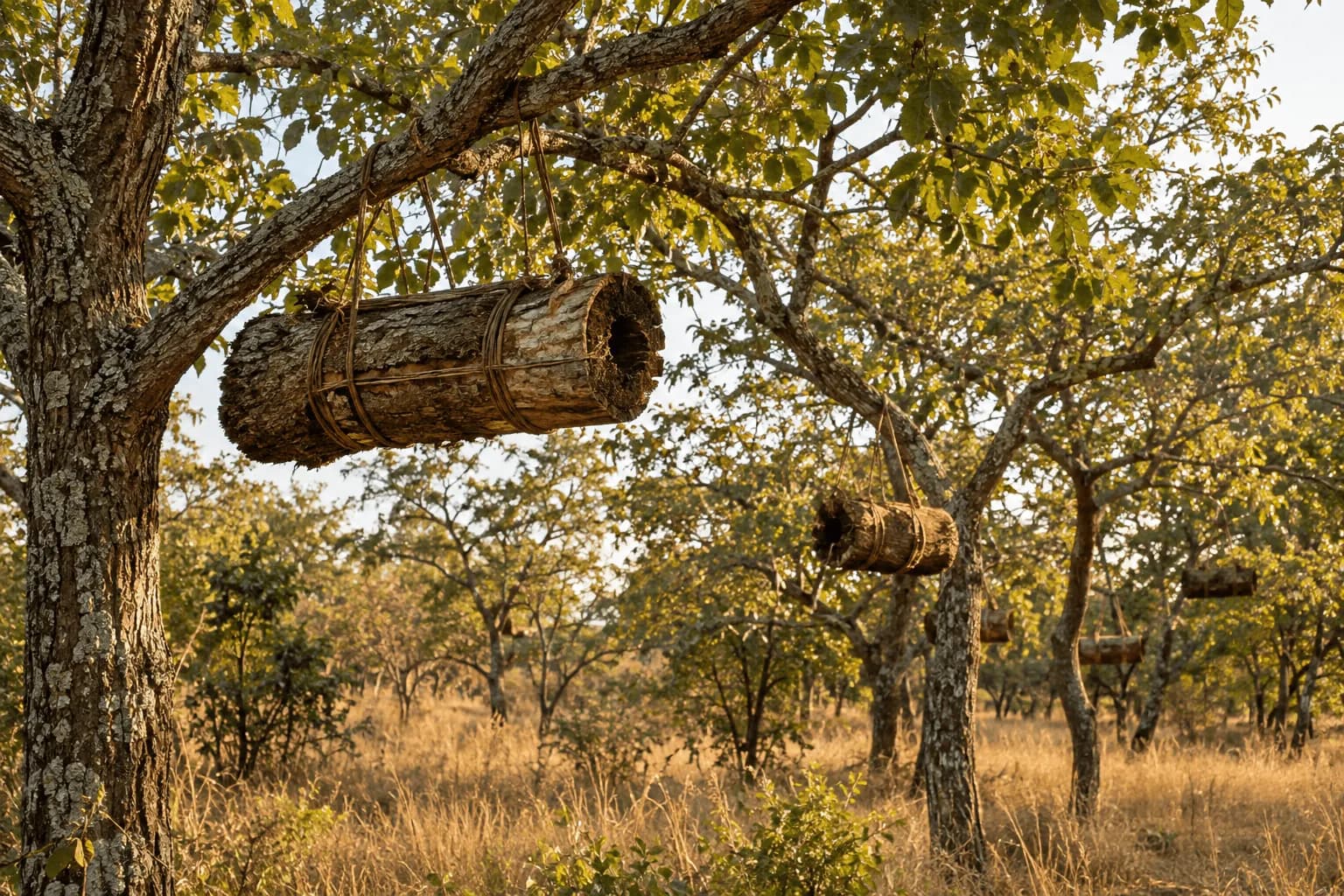
Beekeeping in it looks nothing like European or American apiculture. There are no rows of painted boxes in a field, and no truck moving colonies from almond bloom to clover. A beekeeper hollows out a log or strips a cylinder of bark, binds it, and hangs it high in the branches of a tree — sometimes eight or ten metres up — then leaves it for a swarm to occupy. At harvest the beekeeper climbs back up and takes the combs down. Increasingly the better-organised groups use top-bar and frame hives, which are easier to work and kinder to the colony, but the log hive is still the backbone of the sector.
Two things follow from that, and both matter commercially. The first is that the honey is multifloral by definition — it is whatever the woodland was flowering, which is why nobody credibly sells single-flower Tanzanian forest honey. The second is that these colonies live the way wild colonies live. They are not fed syrup, not moved between crops, and not routinely medicated, because there is no economic logic in treating a hive you visit twice a year. That is a genuine advantage in a market where residue findings have wrecked more than one origin's reputation, and it is also why the country's residue-monitoring programme matters — the claim is worth testing rather than asserting.
Where in Tanzania does it come from?
Tabora first. The region sits in the middle of the western woodland, it has the deepest beekeeping tradition in the country, and it is routinely described as Tanzania's honey capital — Tabora honey has taken prizes at regional quality competitions and it is the region the sector's own branding work has centred on. Katavi, Kigoma, Singida and Shinyanga make up most of the rest, all of them in the same woodland system.
The distance is worth knowing when you read a quote. Tabora is roughly a thousand kilometres from the port at Dar es Salaam, on roads and rail that are fine but not fast. Honey does not deteriorate on a truck the way a fresh product would, but the inland leg is a real cost line and a real scheduling constraint, and any exporter who prices honey as though it appears at the quay is either absorbing that cost or has not thought about it.
What are the two crops?
The main flow runs from roughly May into August, after the long rains stop and the woodland comes into bloom. That crop is golden to light amber — around 50 to 85 millimetres on the Pfund scale — and it reads of figs, caramel and soft stone fruit, usually with a faint smokiness that comes from the traditional harvesting method. It is the crop most packers want, and it is spoken for quickly.
The later harvest, generally October to December, is a different product. It is dark — amber to near-mahogany, above 85 on the Pfund scale — and it is maltier, more mineral and considerably stronger. Its electrical conductivity runs higher, which is simply the analytical signature of a honey carrying more dissolved minerals. Buyers who want honey that still tastes of something after it has been baked, blended or fermented into mead go looking for exactly this, and it usually trades at a discount to the light crop despite being harder to find in volume.
“The light crop sells itself in March. The dark crop is the one experienced buyers wait for, because nobody else is bidding for it.”
- Joachim Mbwana, Sourcing Lead
What is a lot tested against?
The same parameters the EU Honey Directive and the Codex standard are written around, because those are what your own intake QC will check on arrival.
- Moisture: maximum 20 per cent under both standards. Below 18 per cent is the practical threshold for honey that will not ferment in a warm warehouse.
- HMF: maximum 40 mg/kg, relaxed to 80 mg/kg for honey of tropical origin. It measures accumulated heat and age, so fresh, unheated honey should be far below the limit.
- Diastase activity: minimum 8 on the Schade scale. It confirms the enzymes survived, which is what makes the word raw mean anything.
- Fructose plus glucose: at least 60 g per 100 g for blossom honey, with sucrose no higher than 5 g per 100 g.
- Electrical conductivity: no more than 0.8 mS/cm for blossom honey. The light crop sits inside that comfortably; the dark crop runs higher and we state the measured figure rather than a range.
- Free acidity below 50 milliequivalents per kilogram, and water-insoluble solids below 0.1 g per 100 g for honey that has been strained rather than pressed.
Two of those deserve emphasis because buyers routinely specify one without the other. HMF and diastase are a pair. A honey that has been heated hard to make it pump easily will show elevated HMF and depressed diastase together; specifying only HMF lets a lot pass on a technicality, and specifying only diastase misses age. Write both into the contract.
How does it get to your warehouse?
Honey is settled and strained close to where it is harvested, then filled into 300 kg food-grade drums — occasionally 25 kg pails where a buyer wants smaller units. The drums are trucked or railed to Dar es Salaam and loaded there. A 20-foot container takes around 18 tonnes, which is worth pausing on: honey is one of the very few agricultural cargoes where you reach the payload limit long before you fill the box. That is a nuisance if honey is all you are buying and a genuine advantage if it is not, because a pallet of drums will soak up the weight allowance that bagged sesame leaves on the table.
On the paperwork side, honey is an animal-origin product in EU terms, which puts it in a stricter documentary category than a seed or a nut. Tanzania holds third-country approval for it, resting on the residue-monitoring plan the Tanzania Forest Services Agency files with the Commission annually, and the sector has been organising itself — a national honey trademark was launched in Tabora in 2024 to hold quality standards across the industry. None of that removes the per-consignment work: lot analysis, health documentation and a compliant label, prepared against the specific member state you are importing into.
Related reading
Leave a Comment
Your email address will not be published.