

At a glance
- Neither the EU Honey Directive nor Codex defines raw, so the word alone guarantees nothing.
- Pasteurisation buys shelf clarity at the cost of enzymes and aroma, and leaves its signature in elevated HMF.
- Pressure filtration removes pollen, and with it the physical evidence of origin.
- Crystallisation is set by a honey's own glucose-to-fructose ratio — it is a sign nothing was done to prevent it.
- HMF and diastase activity, read together, are the only reliable test of a raw claim.
- Raw honey is a harder product to merchandise and an easier one to verify.
Raw is the most abused word on a honey label. It appears on jars that have been heated to 70 degrees and filtered until no pollen remains, and it appears on drums that genuinely never went above hand-warm — and no regulation separates the two, because neither the EU Honey Directive nor the Codex standard defines the term at all. For a bulk buyer that is not an academic problem. It means the word in a supplier's offer carries no information, and you have to get the information somewhere else.
What does processing actually do?
Two operations account for nearly all of it, and they solve two different commercial problems.
Pasteurisation — heating honey to roughly 70°C and cooling it quickly — exists to keep honey liquid and clear. The heat dissolves the microscopic sugar crystals that would otherwise seed granulation, and it kills the osmotolerant yeasts that ferment honey carrying too much moisture. A packer selling into a supermarket that expects a clear, pourable jar for eighteen months has an obvious reason to do it. What is lost is enzyme activity and the volatile aroma compounds that carry a honey's character, and the heat leaves a trace: hydroxymethylfurfural rises measurably.
Filtration is the other half. Straining through a coarse mesh to remove wax fragments, bee parts and woodland debris is simply good practice, and every honey worth buying has been strained. Pressure filtration through fine media is a different operation with a different result: it produces a brilliantly clear, slow-crystallising honey, and it removes the pollen. Pollen is the only physical evidence of where a honey came from, so a pollen-free honey cannot be verified against its own origin claim — which is precisely why it draws attention in markets concerned about origin fraud.
Why does raw honey crystallise?
Because honey is a supersaturated solution of sugars in a small amount of water, and that state is metastable. Glucose comes out of solution over time; the rate depends on the ratio of glucose to fructose in that particular honey, and on temperature. Some honeys set in weeks, others stay liquid for a year, and both can be excellent.
What matters commercially is that crystallisation is the absence of intervention, not the presence of a defect. Packers who want a liquid product bring the honey back with gentle warming below 40°C; packers who lean into it control the crystal size deliberately and sell a smooth creamed set at a premium. The only offer that should worry you is a raw honey promised never to granulate, because there are exactly two ways to achieve that and both of them contradict the word raw.
“Ask a supplier what their honey's HMF and diastase are. If the answer is a sentence about tradition rather than two numbers, you have learned what you needed to know.”
- Neema Kessy, Editorial Lead
How do you verify a raw claim?
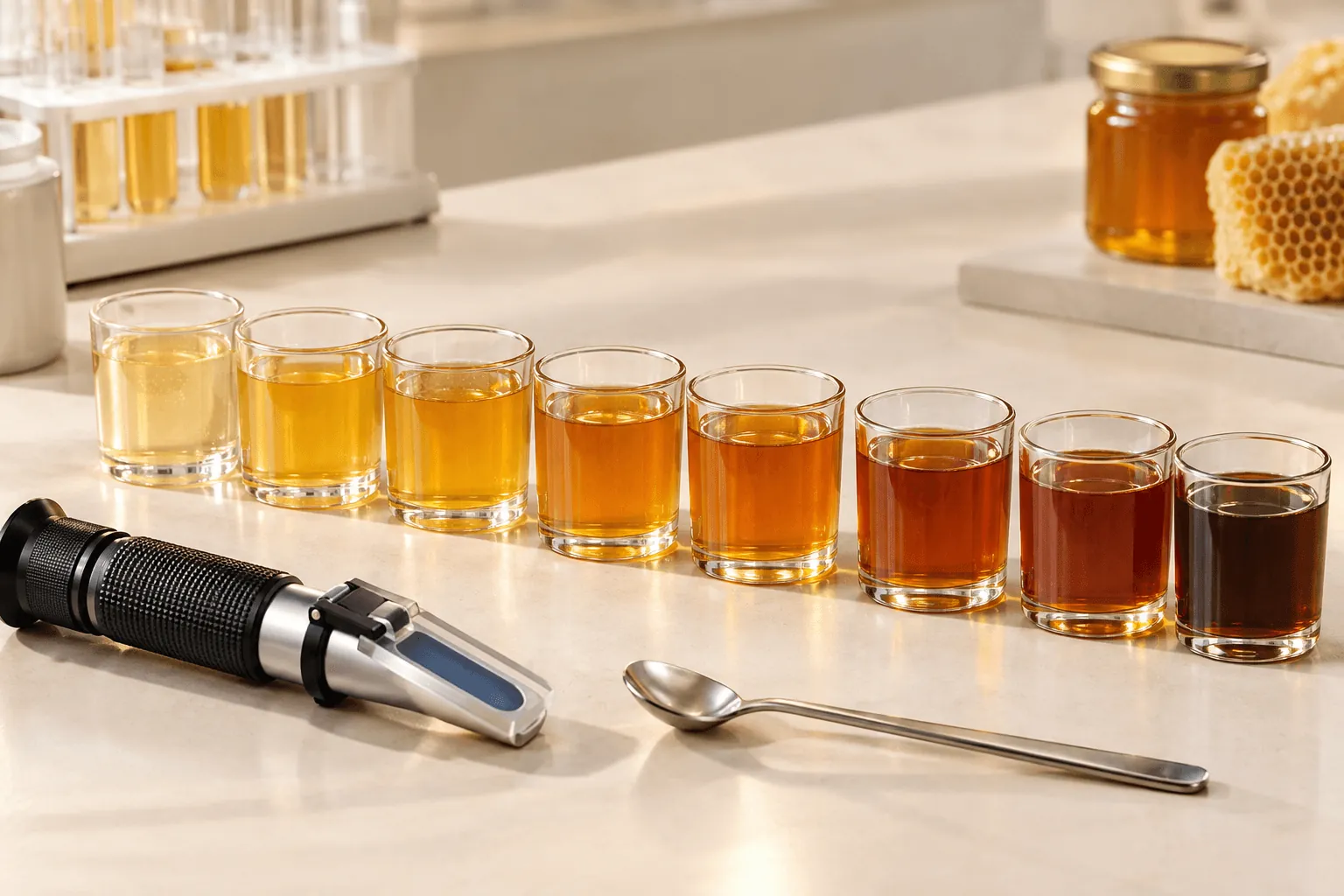
With the two measurements that record what heat did. HMF should be low — the legal ceiling is 40 mg/kg, with 80 allowed for tropical honey, but genuinely unheated honey tested soon after harvest generally sits in single figures or the low teens. Diastase activity should be well clear of the floor of 8 on the Schade scale. Together they are hard to fake, because the operations that lift HMF are the same ones that depress diastase.
Add one more question if origin matters to your label: ask whether the honey has been pressure-filtered, and ask for a pollen analysis. A supplier of genuinely raw forest honey will be able to show you pollen consistent with the woodland it came from. A supplier who has filtered that evidence out will explain why the question is unfair.
Which one should you buy?
It depends entirely on what happens next to the honey, and we have no interest in pretending otherwise. A manufacturer dosing honey into a hot process is going to destroy the enzymes anyway, and paying for a raw specification to then cook it is a waste of money — buy on flavour, colour and price. A retail brand whose proposition is minimally processed food, a specialty packer selling a creamed set, or anyone whose label leans on origin should buy raw and should verify it.
What we would resist in both cases is treating raw as a marketing adjective. It describes a set of things that were not done to a product, and it is worth exactly as much as the numbers that prove they were not done.
Related reading
Leave a Comment
Your email address will not be published.