
At a glance
- Both origins grow washed arabica at altitude and grade it the same way: AA, A, B, PB and C by screen size and density.
- SL28, the variety behind Kenya's reputation, was selected in Kenya from drought-tolerant stock collected in Tanganyika — and is grown in Tanzania too.
- Kenya sells almost all its arabica through the Nairobi Coffee Exchange; Tanzania through the Moshi auction or by direct export.
- Kenya's top lots are more consistently intense. Tanzania's are often rounder, and cheaper for a reason that is mostly reputation.
- Tanzania is the origin most associated with peaberry sold as its own grade.
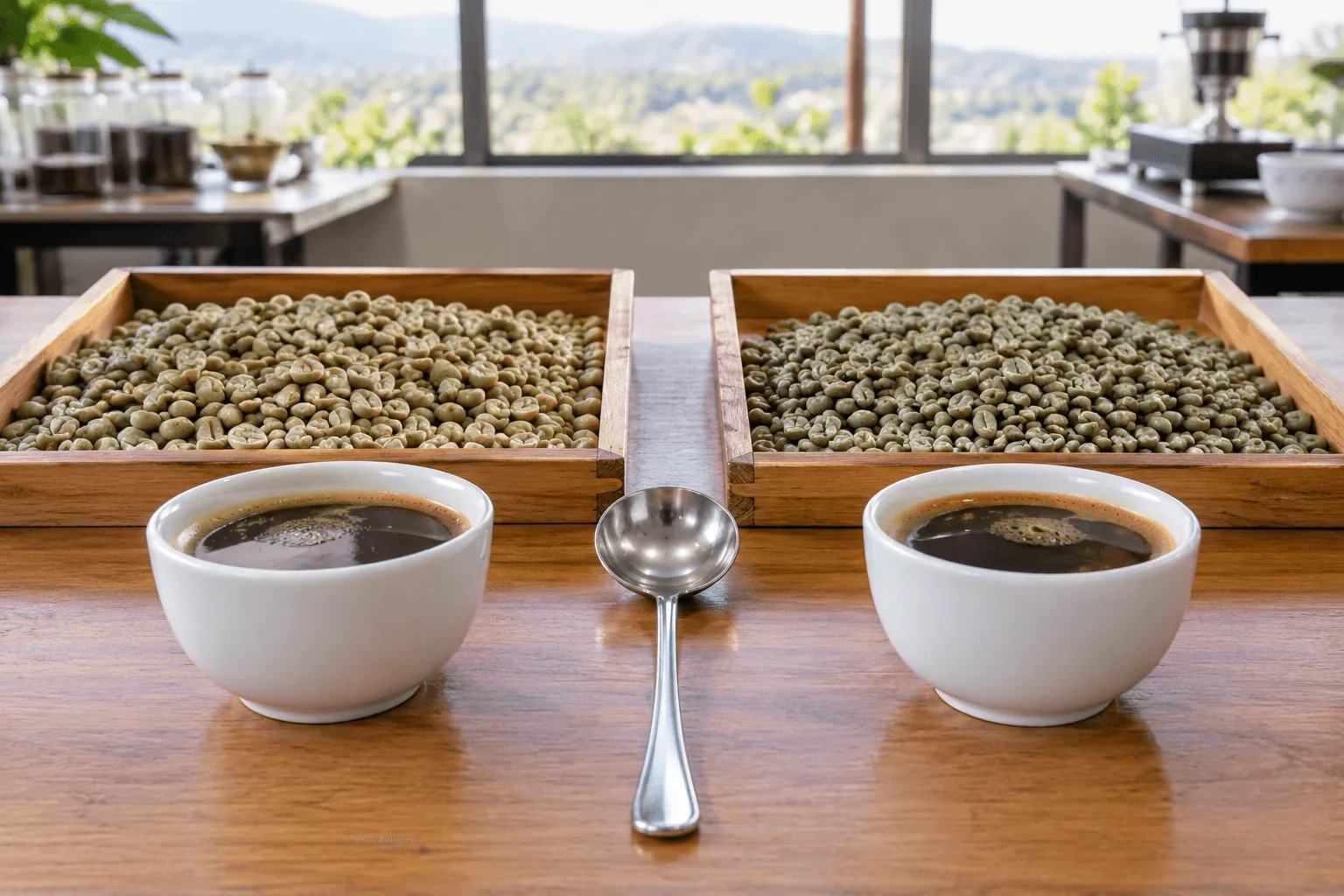
- The only comparison that settles it is a blind cupping of both, on the same roast.
Kenya and Tanzania share a border, a mountain system and a coffee vocabulary, and their green coffee is closer than the price gap between them suggests. Kenyan coffee carries one of the strongest reputations in the trade, and it has earned it. Tanzanian coffee carries a weaker one, and a good part of that is simply that fewer buyers have cupped it side by side. This is a guide for the buyer deciding between them — written from the Tanzanian side, so read it with that in mind.
What do they have in common?
More than most comparisons admit. Both countries grow arabica on high volcanic slopes, most of it fully washed, and both grade it on the same principles: screen size and density, with AA at the top, A and B below it, PB for peaberry and C for smaller beans. A buyer who can read a Kenyan offer sheet can read a Tanzanian one.
The varieties overlap too. SL28 and SL34 — the Scott Laboratories selections that define Kenyan coffee — are grown in Tanzania, and SL28 itself was selected in Kenya from drought-tolerant plants collected in what was then Tanganyika. Tanzania adds its own long-established cultivars, above all Bourbon and Kent types and research-station selections such as N39. The genetic distance between a good Kenyan and a good Tanzanian lot is small.
Where do they actually differ?
- How the coffee is sold. Almost all Kenyan arabica goes through the Nairobi Coffee Exchange auction. Tanzanian coffee goes through the Tanzania Coffee Board auction in Moshi, or — for licensed premium coffee — by direct export, which gives an importer a clearer line to a specific lot.
- How grades are packaged. Kenya commonly sells A and B blended as AB. Tanzania more often trades A and B separately, which suits a roaster who wants to buy only the band they need.
- Consistency at the top. Kenya's best lots are reliably intense — the vivid blackcurrant acidity that sells Kenya AA. Tanzania's top lots can match them, but the range across the crop is wider, so the lot matters more than the label.
- Peaberry. Tanzania is the origin most associated with selling peaberry as its own grade, and Tanzanian PB has a name with end consumers that most origins' peaberry does not.
“Put a Kenyan AA and a Tanzanian AA on the same table, same roast, labels turned over. That half hour has changed more buying decisions than anything we could write.”
- Joachim Mbwana, Sourcing Lead
How do the cups compare?
In broad strokes: Kenya is brighter and more intense, with the blackcurrant and citrus acidity that defines it and a heavier body. Northern Tanzanian lots from Kilimanjaro and Arusha sit closest to that profile — bright and winey. Southern Highlands lots from Mbeya and Songwe tend to read rounder, with more chocolate and caramel and softer acidity. For a single-origin espresso that needs to shout, Kenya is the easier choice. For a balanced filter coffee, or a blend component that adds brightness without dominating, Tanzania often does the job for less money.
Why is there a price gap?
Partly quality, partly consistency, and a good deal of reputation. Kenya built its name over decades of marketing and a tightly run auction, and buyers pay for the certainty that a Kenya AA will cup like a Kenya AA. Tanzanian coffee has not had the same investment in its name, so comparable lots can trade at a discount. That gap is the opportunity — and the risk. The opportunity is paying less for a cup you would have bought anyway. The risk is buying the label instead of the lot, which in Tanzania matters more because the range across the crop is wider.
Which should you buy?
Buy Kenya when you need maximum intensity and a name your customers already know. Buy Tanzania when you want East African brightness at a better price, when you want peaberry sold as peaberry, or when direct export lets you build a repeat relationship with a known source. Many roasters end up with both — Kenya for the headline coffee, Tanzania for the workhorse and the blend. Whichever way you lean, cup a sample from the actual lot before you contract. The grade tells you the bean size; only the cup tells you what you are buying.
Next steps
- Tanzanian green coffee, every grade- AA, A, B, peaberry and robusta on our coffee site
- Tanzanian Arabica AA Green Coffee: A Buyer's Guide- regions, seasons and how a container is bought
- Tanzania Coffee Grades Explained- AA, A, B, PB and the long tail below them
- Tanzanian Peaberry Green Coffee- the PB programme and its specification
- Request a green coffee sample- name the grade, region and destination
Related reading
Leave a Comment
Your email address will not be published.