

At a glance
- Fix moisture as a maximum: 20 per cent is the legal ceiling, 18 per cent is the practical one.
- Always specify HMF and diastase together — either alone can be satisfied by a heated honey.
- State colour on the Pfund scale, not in adjectives, and say whether substitution is allowed.
- Decide before you contract whether you need a botanical or geographic origin claim, because your label will be audited at your end.
- Name the residue and authenticity panel, the laboratory and the tolerance up front.
- Require lot marking on every drum, tied to the certificate issued for it.
Almost every honey dispute we have seen or heard about started the same way: the honey was fine, the contract was vague, and two parties discovered after arrival that they had been imagining different products. Honey is unusually exposed to this because it looks simple. It is one ingredient with no grades, no sieve sizes and no defect counts — and that apparent simplicity tempts buyers into a purchase order that says raw honey, 20 tonnes, and very little else. What follows is the specification we would want to receive.
1. Fix the moisture ceiling
Moisture is the parameter that decides whether your honey is still honey in six months. Above roughly 20 per cent, the osmotic pressure that keeps honey sterile weakens enough for naturally present yeasts to start working, and a fermenting drum announces itself with a sour smell and a bulging lid. Both the EU Honey Directive and the Codex standard cap it at 20 per cent for ordinary honey.
Write a maximum rather than a target, and consider going below the legal line. In a tropical origin the difference between 19.5 and 17.5 per cent is the difference between a lot that must be moved promptly and one you can hold through a slow quarter. It is achievable — it depends on when the combs are taken and how the honey is settled — but only if the requirement exists before the harvest, not after.
2. Specify HMF and diastase as a pair
This is the single most common gap in the specifications we are sent. Hydroxymethylfurfural accumulates as honey is heated or ages, so it is the standard proxy for thermal abuse; the EU and Codex limit is 40 mg/kg, relaxed to 80 mg/kg for tropical honey, and many European buyers contract for 10 or 15 as a matter of course. Diastase activity measures the natural enzymes that are still present, with a floor of 8 on the Schade scale.
Read separately, each can mislead. Fresh honey that has been through a hot plate filter can still show acceptable HMF if it was heated briefly, while its diastase has already fallen. An old but gently kept honey can hold its enzymes while HMF creeps up. Read together they describe the honey's whole thermal history, and there is no way to satisfy both with a lot that has been cooked. If you write one line into a honey contract, write this one.
“A specification that names HMF but not diastase is telling the supplier which corner they are allowed to cut.”
- Asha Ngonyani, Quality Manager
3. Describe the colour band you actually want
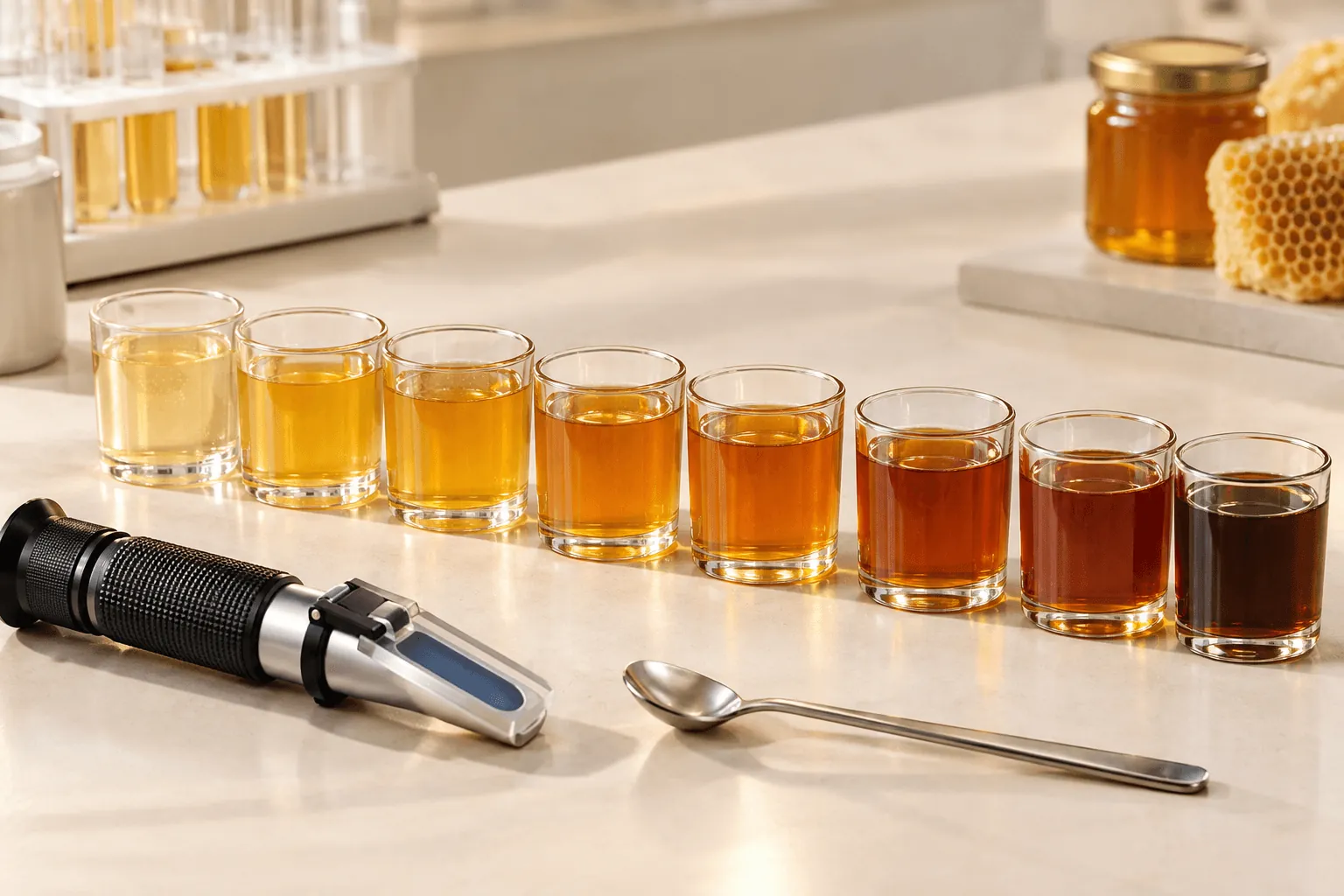
Colour is the biggest single driver of price within one origin, and it is the parameter buyers are most likely to describe in words. Use the Pfund scale instead: water white at one end, through extra light amber and light amber in the 50 to 85 millimetre range, to amber and dark amber above that. Then answer the question the supplier will otherwise have to guess — if the light crop is committed, may a darker lot be shipped against this contract, at what adjustment, or not at all?
4. Decide what origin claim you need
Forest honey from a woodland system is multifloral. It cannot honestly be sold as a single-flower honey, and an exporter who offers to describe it as one is telling you something useful about the rest of their practice. If your own label will carry a geographic or botanical claim, put that claim in the contract and require the pollen analysis that supports it — because the claim will be audited at your end, under your name, not at the exporter's.
5. Agree the residue and authenticity panel in advance
Honey has an adulteration problem globally, and every serious importing market now screens for it. Stable carbon isotope ratio analysis remains the workhorse test for added cane or corn sugar, and NMR profiling has become the standard second layer for checking botanical and geographic consistency against reference databases. Residue screening requirements vary by market and are the reason exporting countries maintain national monitoring plans in the first place.
Name the tests, name an acceptable laboratory and name the tolerance before anything is loaded. A test agreed in the contract produces a pass or a fail. The same test introduced after arrival produces a negotiation, and the party holding the container usually loses it.
6. Specify packing, filling temperature and lot marking
Say what the honey travels in — 300 kg food-grade drums are the trade standard, with 25 kg pails for smaller parcels — and say what liner you expect. Put a ceiling on the temperature the honey may be warmed to for filling, because that is the exact point at which a supplier under time pressure damages HMF and diastase in a single afternoon.
Then add the line that almost nobody writes: every drum is to be marked with the lot number that its laboratory certificate is issued against. Honey is homogeneous, drums look identical and a container holds sixty of them. Without lot marking, the certificate you were sent describes an abstraction rather than the specific drum your QC team has just opened — and on the one occasion that distinction matters, it matters completely.
Related reading
Leave a Comment
Your email address will not be published.