

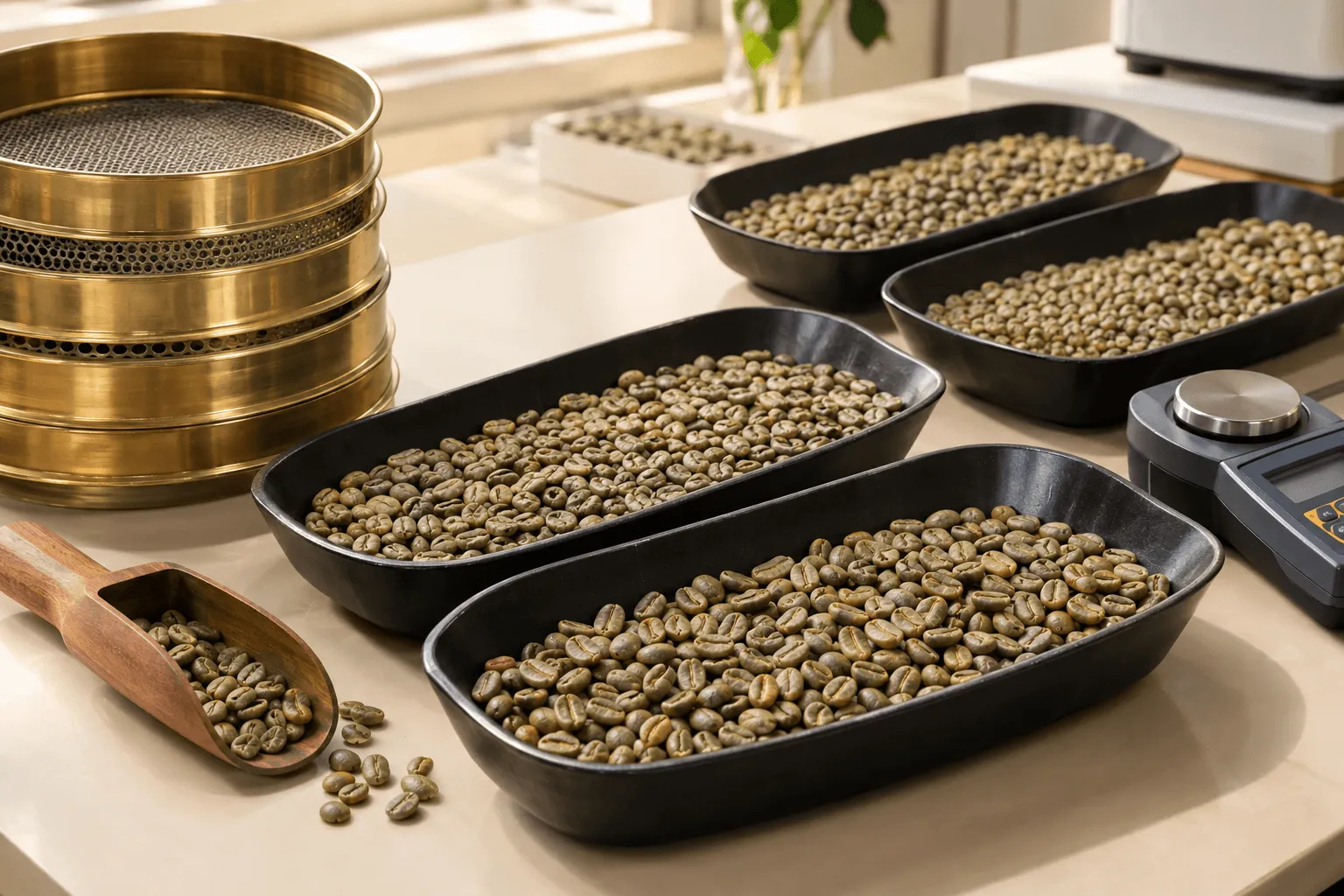
At a glance
- Tanzanian arabica export grades run AAA, AA, A, B, PB, C, E, F, AF, TT, UG and TEX.
- AA is screen 18+ (about 7.1 mm), A is screen 17 (6.75 mm), B is screen 16 (6.35 mm).
- PB is peaberry — separated by shape, not screen, and roughly one cherry in twenty.
- Robusta from Kagera uses Extra (screen 18), Superior (screen 16) and triage (below screen 12).
- Grades measure size and density. They are a roast-evenness signal, not a cup score.
- Four grades — AA, A, B and PB — cover almost every commercial conversation.
A Tanzanian offer sheet can list a dozen grades, and a new buyer reasonably assumes they run from good to bad. They do not. They run from big to small. Understanding that one distinction is most of what you need to read an offer properly, and it stops you paying a premium for something you did not actually want.
How does screen grading work?
Green coffee is poured over a stack of perforated metal sieves. Each screen number is the hole diameter in sixty-fourths of an inch, so screen 18 has holes eighteen sixty-fourths across — about 7.1 mm. Beans that stay on top of the screen 18 sieve are screen 18 and above. What falls through goes onto the next sieve down, and so on.
Tanzania adds density to the assessment, usually on a gravity table, so a bean that is large but under-developed and light does not ride into the top grade on size alone. That combination — big and dense — is what the AA mark is actually certifying.
The grades that matter commercially
- AA — screen 18 and above, roughly 7.1 mm. The premium size band, bought for even roasting and for the name.
- A — screen 17, about 6.8 mm. Same crop, same stations, one band down, and often the better value.
- B — screen 16, about 6.35 mm. The workhorse of blends and private-label programmes.
- PB — peaberry. Rounded single beans separated by shape; roasts evenly and sells on its own story.
Those four cover nearly every conversation we have. AAA exists but is rare enough that it is not worth planning a programme around. Everything below B — C, E, F, AF, TT, UG, TEX — covers smaller beans, oversized and often malformed elephant beans, light and broken material and off-grade lots. They trade at real discounts and they have legitimate buyers in blending and soluble extraction, but they are not what a specialty or supermarket roaster is shopping for.
“Screen size tells you how the coffee will roast. The cupping table tells you how it will taste. Buyers who confuse the two overpay in one direction and miss good lots in the other.”
- Asha Ngonyani, Quality Manager
Why does peaberry get its own grade?
A normal coffee cherry contains two seeds pressed flat against each other. Occasionally only one seed develops, and having nothing to flatten against it grows round — a peaberry. It happens in perhaps five per cent of cherries, and because the shape is so distinct it can be separated mechanically and sold on its own.
The practical argument for it is real: a round bean has no flat face to sit against hot metal, so it tumbles and roasts more evenly, which matters in small batches and in capsule and single-serve production. The romantic argument — that all the cherry's flavour concentrated into one bean — is folklore, and you will hear it anyway. Tanzania markets peaberry harder than most origins, and it is one of the few places where PB has genuine name recognition with end consumers.
What about robusta?
Tanzanian robusta, grown in Kagera on Lake Victoria, is graded on a separate scale that maps to screen rather than letters. Extra is screen 18 and is the band that scores well enough to interest quality-conscious espresso blenders. Superior is screen 16 — good appearance, no musty flavours, a controlled defect count. Below screen 12 sits triage: small and broken, priced accordingly.
Which grade should you buy?
Work backwards from what the coffee has to do. If you are roasting small batches and selling single-origin by name, AA or PB earn their premium — roast evenness and a story you can put on a bag. If you are running a commercial blend at volume, A and B deliver the same cup character for less money, and the size difference disappears the moment the coffee is ground.
Whichever you choose, cup a sample from the actual lot before you contract. The grade tells you the bean size. Only the cup tells you whether you want it.
Related reading
- Reading a green coffee spec sheet- Screen, moisture, defects and water activity
- Tanzanian Arabica AA Green Coffee: A Buyer's Guide- regions, seasons and how a container is bought
- Tanzanian Peaberry Green Coffee- the PB programme and its specification
- How to Vet an African Commodity Supplier- the due diligence behind any grade
Related reading

Leave a Comment
Your email address will not be published.