
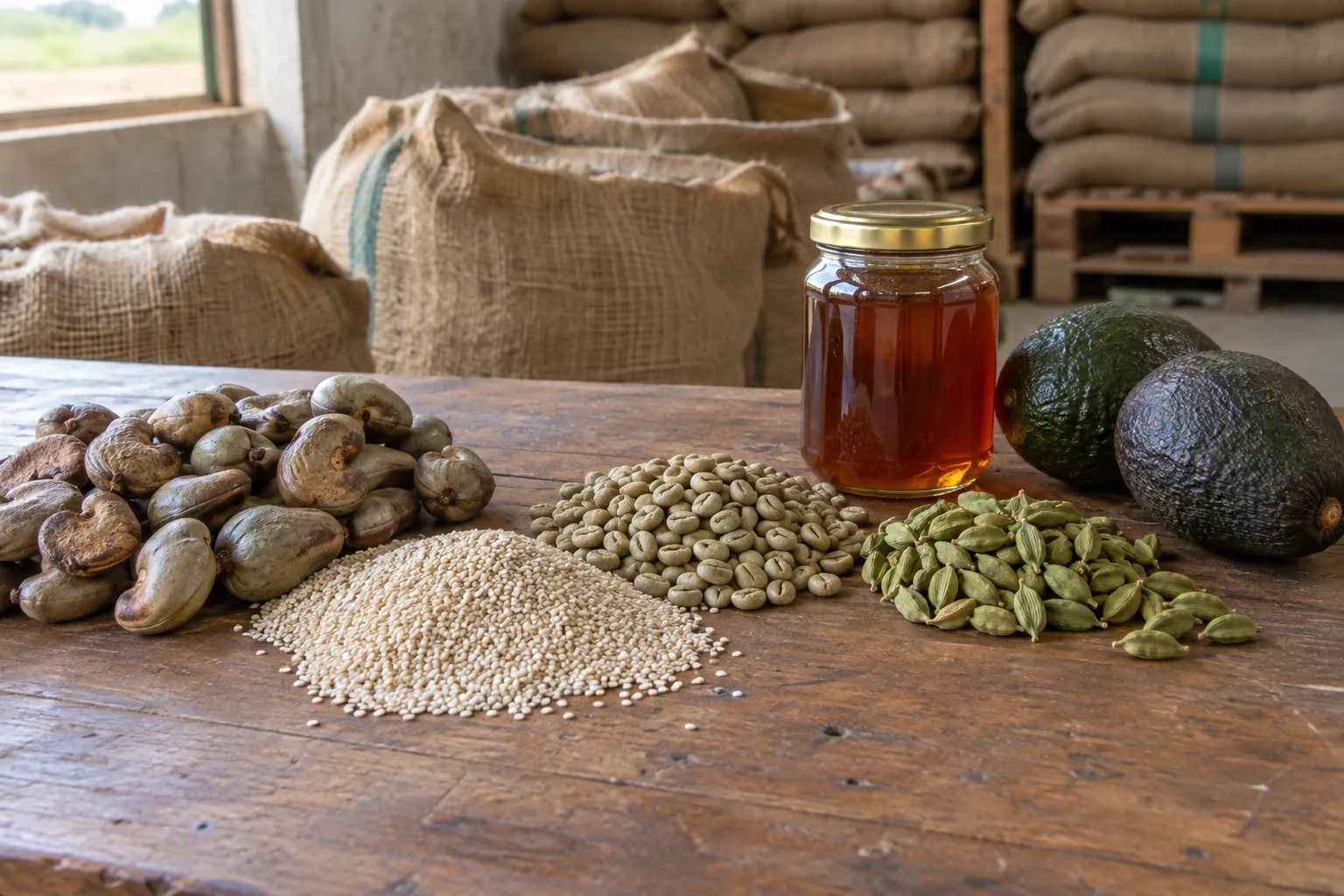
From October to December 2026 the crops actually coming in across Tanzania are cashew and cardamom. The Cashewnut Board of Tanzania opened the 2026/27 raw-cashew auctions on 12 October, and cardamom is in its main picking and curing window. Outside Tanzania, the vanilla we supply from Madagascar is coming out of cure under a new export campaign, and Uganda's next vanilla harvest is close. Sesame and green coffee are shipping from crop harvested earlier in the year. Hass avocados are out of season until around February, so this is the quarter to plan avocado programmes, not to receive fruit.
Below is one short section per product family: what the crop is doing this quarter, what is moving, and what to settle with a supplier before the year closes. The commodity detail sits on each product's own site, linked at the end of each section. Season windows hold in a normal year; check the current position with origin before you fix a date.
The quarter at a glance
- Cashew: harvest under way; 2026/27 raw-nut auctions open since 12 October.
- Sesame: harvest finished in August; export volume at its third- and fourth-quarter peak from stored, cleaned crop.
- Green coffee: arabica picking closing around October; new-crop lots milled and traded through the July–June marketing year.
- Cardamom: main picking and curing window, about September to December; new-crop exports peak in the fourth and first quarters.
- Hass avocados: out of season; fix February programmes now.
- Vanilla (Madagascar and Uganda): first 2026–27 list of approved Madagascar exporters published 19 October; new cure reaches export condition from about November.
Cashew: the 2026/27 auctions are open
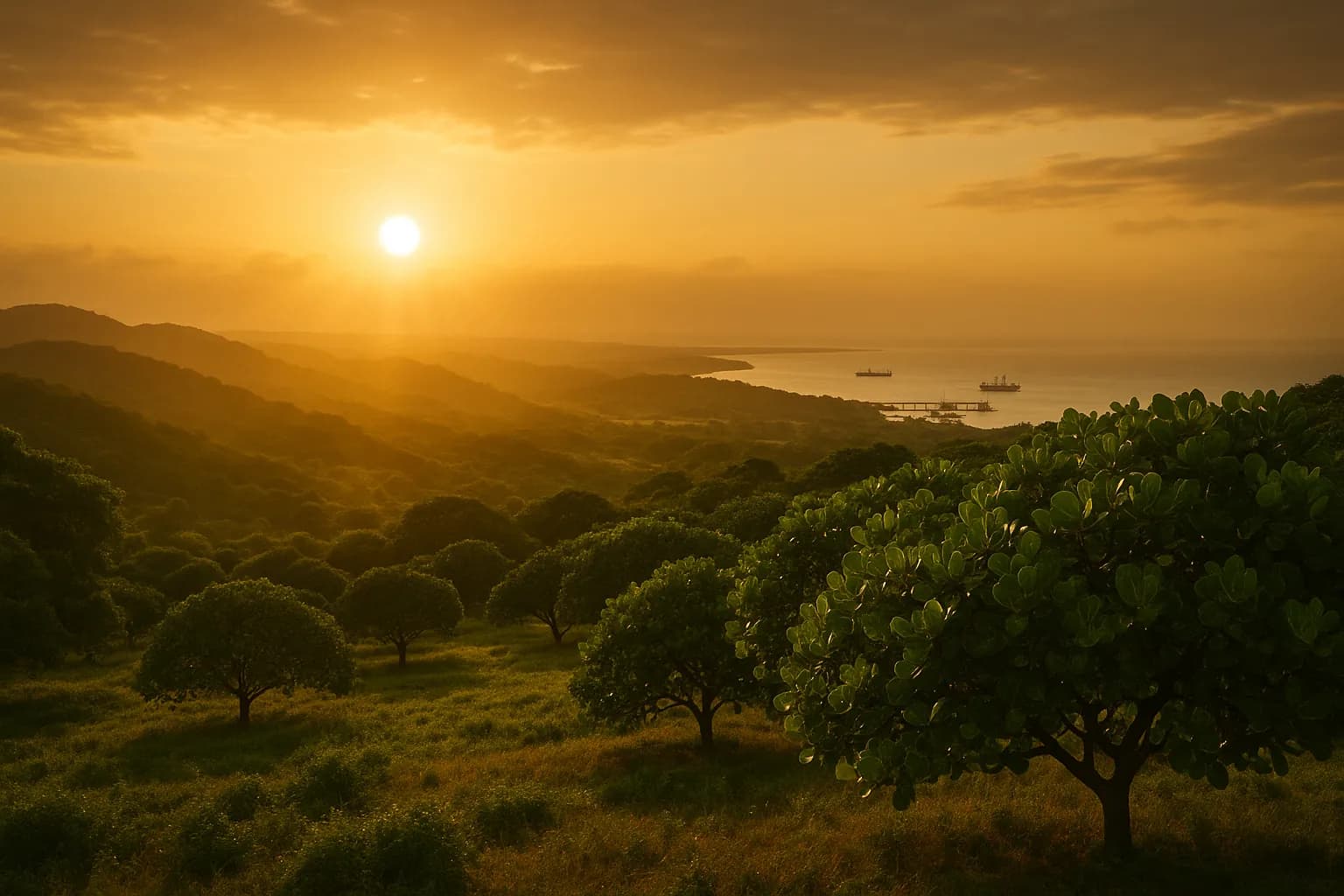
In a notice dated 27 September, the Cashewnut Board moved the first auction of the season from 19 October to 12 October, and the opening sale went ahead in Masasi that day. A local radio report said a network fault stopped it after five of 64 lots and that the sale resumed on 13 October. Auctions then move between cooperative unions as the southern harvest, which runs October to January, comes into the warehouses. Raw cashew nut supply is heaviest from October through March; processed kernels come from stored crop and ship throughout the year.
What to line up: for raw nuts, the out-turn and moisture you will accept and the district behind the lot; for kernels, the W-grade, packing and shipment month. Treat any auction date as a sale date. Ask how long payment, release and the vessel booking will take from Mtwara or Dar es Salaam before you accept a loading window.
Sesame: shipping from the stored crop
Sesame is not harvested in this quarter. The crop came off the fields between May and August and, once threshed, dried and cleaned, it moves at its export peak through the third and fourth quarters. Cleaned seed keeps in dry, ventilated warehouses, so a buyer in November is choosing from identified stock rather than waiting for a harvest. Most lots load at Dar es Salaam, with Mtwara used for seed grown in Lindi and Mtwara.
What to line up: purity, oil content, free fatty acids and the aflatoxin limit of your market, then a sample drawn from the lot you will actually receive. The next crop is sown with the rains from December to February, so rainfall over the coming months is the first read on 2027 supply.
Green coffee: new-crop offers, and the EUDR date
Arabica is picked from around June to October, the Southern Highlands usually first, and Kagera robusta from around May to August. By the fourth quarter the cherry is off the trees and the work is milling, grading and selling, through the Tanzania Coffee Board auctions or by direct export, across a marketing year that runs July to June. Afri Exports supplies green coffee only, quoted FOB Dar es Salaam, with samples sent by courier.
For buyers in the EU the date that matters this quarter is 30 December 2026. The European Commission's 13 July 2026 update confirms that the Deforestation Regulation applies from then for large and medium operators, and from 30 June 2027 for most micro and small operators. Coffee placed on the EU market must be covered by the operator's due-diligence statement, which rests on the geolocation of the plots it was grown on. A lot contracted in November may well land after 30 December, so the plot data, its format and who supplies it belong in the contract now.
Cardamom: picking and curing at full stretch
Pods on a cardamom plant ripen unevenly, so growers in the Uluguru Mountains of Morogoro and the Usambara Mountains of Tanga pick in rounds. The main picking and curing window runs from about September into December, and new-crop export volume peaks across the fourth quarter and into the first quarter of the next year. Pods are cured slowly to about 10–12 per cent moisture before sizing, and the lots load at Dar es Salaam.
What to line up: the screen size you need, from Extra Bold at 8 mm and above down to Shipment at around 6 mm; the colour standard; a moisture ceiling; and, if your buyers ask for it, volatile-oil content. Ask for a sample from a cured, graded lot rather than from fresh-picked pods.
Hass avocados: the planning quarter
Tanzania's avocado export window runs from about February to mid-September, so there is no new Tanzanian fruit to ship this quarter, and a supplier who offers some should explain where it was grown. The fourth quarter is when an importer fixes the February programme: count per 4 kg carton, Class I or better, the dry-matter minimum (21 per cent is the regulatory floor; European importers generally want 23), pulp temperature, controlled atmosphere for long lanes, and a reefer temperature trace with the documents.
Avocados are the one perishable line. They ship refrigerated, usually from Mombasa in Kenya because that is where East Africa's reefer capacity and sailing frequency are, and they never share a container with dry goods. Plan them as a separate booking with separate documents. GlobalG.A.P. certification belongs to the farm and packhouse that hold it, so ask for the named packhouse and its certificate reference and check it in the scheme's own database. Avocados have no vertical site of their own; the detail is in our two avocado guides.
Vanilla: Madagascar's new campaign and Uganda's next harvest
Vanilla is the one product family on this page that does not grow in Tanzania. We supply it from Madagascar's Sava region and from Bundibugyo and Mukono in Uganda, and it ships from those origins, usually by air or as vacuum-packed LCL by sea. Madagascar's green pods were picked between roughly June and September, and the cure that follows takes months, so the new crop reaches export condition from about November into January. On 19 October 2026 the Ministry of Commerce and Consumption published its first list of 141 exporters approved for the 2026–27 campaign. Uganda harvests twice a year, and its next harvest falls roughly between December and February.
What to line up: grade (Grade A gourmet or Grade B extraction), length band, moisture band and vanillin range, with the lab method and the date the sample was drawn. For a Madagascar lot, ask which approved exporter will appear on the export documents and make the shipment window conditional on that exporter's 2026–27 approval. Cured beans from earlier campaigns are likely to be on offer alongside the new cure, so ask for the curing window of the specific lot. Ugandan beans are Vanilla planifolia cured in the Bourbon method, not Bourbon-origin vanilla, and should be labelled and contracted as Ugandan.
Vanilla in depth
- Madagascar's 2026–27 vanilla export campaign: what buyers should check- wholesalevanillabeans.com · the approved-exporter list and contract terms
- Madagascar vs Uganda vanilla- wholesalevanillabeans.com · profile, vanillin and calendar compared
- Madagascar vanilla beans- Sava region · Grade A and Grade B
- Ugandan vanilla beans- Bundibugyo and Mukono · two harvests a year
What to send a supplier before December
- Product and grade, with the specification you test against on arrival.
- Volume, and whether it is one shipment or a programme across several months.
- Destination port and market, which decide the documents and, for coffee into the EU, the EUDR data.
- The arrival month you need, so the supplier can work backwards through sale, release and the vessel booking.
- The Incoterm you want quoted: FOB by default, CFR or CIF on request.
If one enquiry covers several product families, say so. Dry goods leave from Dar es Salaam or Mtwara; avocados from Mombasa run on their own schedule; vanilla ships from Madagascar or Uganda, usually by air. We reply with what is available against your specification, not with a price list.
Dated sources and further reading
- Cashewnut Board of Tanzania: 2026/27 auction notice- 27 September 2026 · opening moved from 19 to 12 October
- Radio Fadhila: first Masasi cashew auction- 12 October 2026 · Swahili report; sale resumed 13 October
- European Commission: EUDR product scope and tools update- 13 July 2026 · 30 December 2026 and 30 June 2027 dates
- European Commission: EUDR implementation- official guidance, information system and FAQs
- Madagascar Ministry of Commerce and Consumption: first list of 141 approved vanilla exporters, 2026–27- 19 October 2026 · in Malagasy
- The East Africa Harvest Calendar- the full year, quarter by quarter
- Send a Q4 enquiry- grade, volume, destination and arrival month
Related reading
Leave a Comment
Your email address will not be published.